
Last Updated: October 24, 2026
Chiang Mai Hidden Gems
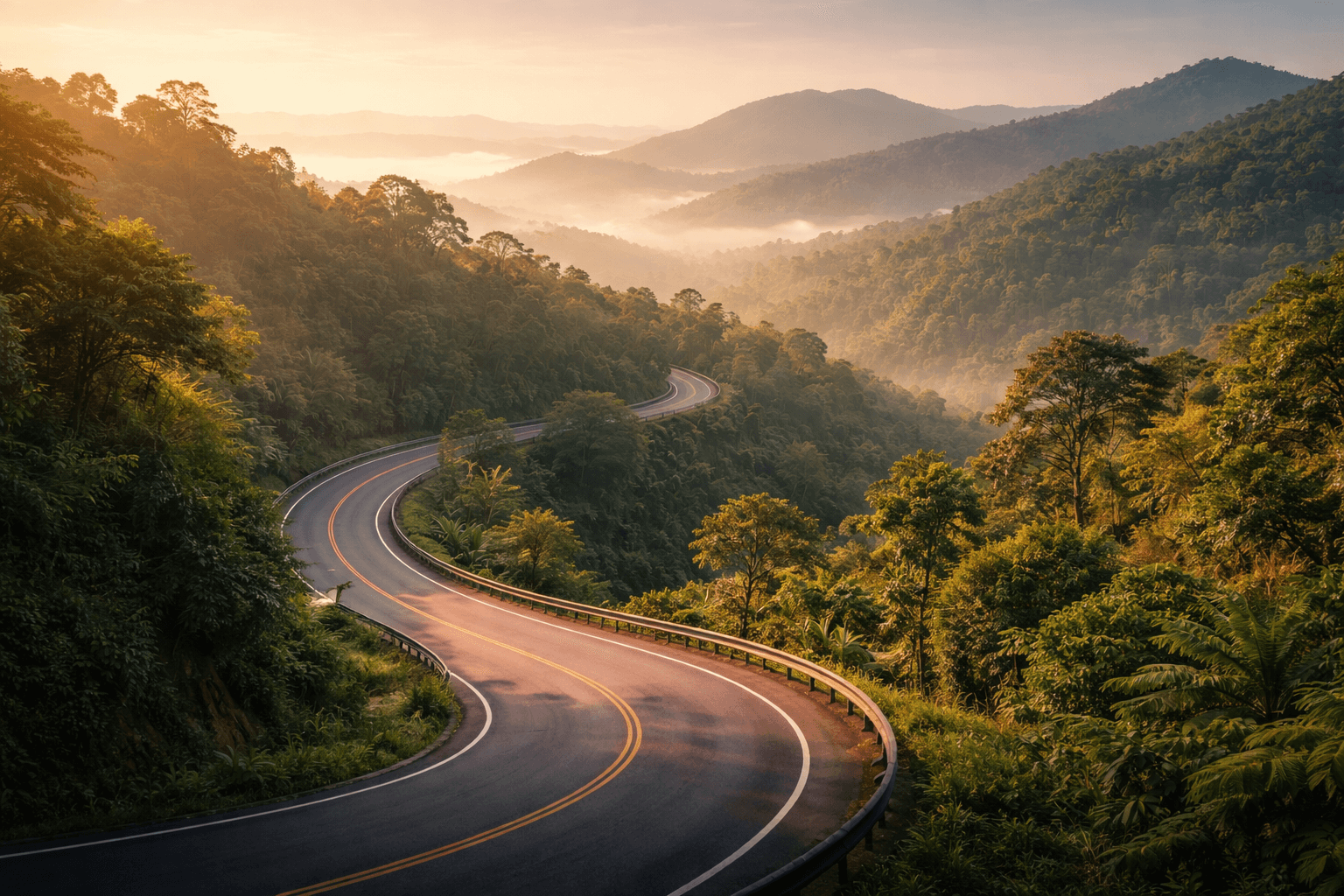
TL;DR: Most Chiang Mai hidden gems aren’t easily accessible without your own transport. This guide is built for exploring the best Chiang Mai hidden gems beyond the Old City, ideally by private driver, car, or Grab, taking you into quieter mountain routes, peaceful viewpoints, and authentic local spots that most visitors never see, precisely because they take more than a top-10 list to find.
Our guide to Chiang Mai hidden gems isn’t a checklist of top attractions you’d see on something like TripAdvisor or Lonely Planet. It’s about exploring northern Thailand deliberately, intuitively, and without over-structuring your days.
Instead of chasing cliché landmarks that appear on almost every itinerary, we focus on mountain regions, tourist-free but still spectacular temples, lesser-known hot springs, wonderful dams, and the in-between spaces most visitors look straight past. Some of these places sit near famous areas, but the difference is mindset, route choice, and ultimately intention. Chiang Mai rewards the keen and patient traveler.
How Chiang Mai Became My Obsession
Note: Most of my Chiang Mai hidden gems spots were not discovered through online research.
While remote working, I was bored one day in Chiang Mai and rented a scooter for four days. That rental turned into four months, and looking back, it became the actual core of my entire relationship with this city. Every morning during that stretch, I’d wake up early, genuinely excited, the kind of feeling you get as a kid on Christmas morning who can’t wait to get outside and play with a new toy. That’s not an exaggeration. It’s exactly what it felt like.
I’ve always found it a little hollow to just follow arrows on a screen. There’s something almost simulation-like about letting Google Maps dictate every turn, you arrive somewhere, but you never really found it. At times I did use Google Maps, of course, it’s practical and I’m not going to pretend otherwise. But 90% of the places that actually mattered to me, the ones I still return to today, weren’t things I searched for. I stumbled onto them by accident, or someone I met along the road pointed me toward them.
That kind of discovery feels fundamentally more authentic to me. It also does something practical: it helps you actually memorize routes and understand a place’s geography in a way that constantly glancing at a screen never will, the same difference between doing mental math and reaching for a calculator every time. One builds real understanding. The other just gets you through the moment.
Chiang Mai became something close to an obsession after that. Even now, whenever I’m in Bangkok and start feeling overwhelmed or worn down by the routine of daily life there, there’s nothing I crave more than getting on a bike and heading straight for my favorite corners of Chiang Mai and the surrounding mountains. And the strange part is, after all these years and all these return trips, I still haven’t run out of new things to find.
Every single time I’m back, I discover something I hadn’t seen before, a new road, a new stop, a new person willing to point me somewhere off the map. That’s really the whole reason this guide exists, not as a checklist, but as an honest record of what happens when you let a place keep surprising you.
Check out our highly customizable northern Thailand itinerary, which includes Chiang Mai and place like Nan. Curious about Nan? Check out my personal Nan story.
New to Chiang Mai? Start with my list of the 35 best things to do in Chiang Mai, then use this guide for the quieter side of the city.
- Chiang Mai Hidden Gems
- How Chiang Mai Became My Obsession
- Chiang Mai Hidden Gems: How to Explore Without Overplanning
- 1. Samoeng Loop
- 2. The Mountains West of Town: Monjam
- 3. East of Chiang Mai: Doi Saket as Sanctuary
- 4. Mae Kampong & Mae On: The Roads That Keep Climbing
- 5. Mae Rim: Where I’d Build a Home
- 6. Doi Suthep: The Layer Most Tourists Miss
- 7. The Quiet Side of Sticky Waterfalls
- 8. Baan Tawai, One of Chiang Mai's Quieter Craft Hidden Gems
- Map: Chiang Mai Hidden Gems & Quiet Spots
- FAQ (Chiang Mai Hidden Gems 2026)
- Are these Chiang Mai hidden gems suitable for first-time visitors?
- What's the best way to explore Chiang Mai hidden gems without rushing?
- Do I need a scooter to visit Chiang Mai hidden gems?
- When is the best time to visit Chiang Mai hidden gems in 2026?
- What should I know about burning season when visiting Chiang Mai hidden gems?
- How much should I budget per day to explore Chiang Mai hidden gems?
- How do I visit temples respectfully at Chiang Mai hidden gems?
- Can Off Path Thailand help plan a trip to Chiang Mai hidden gems?
- What should I not miss in Chiang Mai?
- What are some non-touristy things to do in Chiang Mai?
- What is the most impressive place to visit in Chiang Mai?
- Custom Itinerary Planning: Experience Chiang Mai the Off Path Way
Chiang Mai Hidden Gems: How to Explore Without Overplanning
At a Glance
How to Explore Chiang Mai Hidden Gems Without Getting Too Touristy
Your movement style matters as much as the destination. Keep it simple, stay respectful, and leave space for the road to surprise you.
| Rule | Why It Matters |
|---|---|
| Don’t rely entirely on Maps | Use it for orientation, but allow space for detours and wrong turns, that’s where real hidden gems often live. |
| Talk to shop owners | Casual conversations can unlock places that aren’t blogged, pinned, or packaged for visitors. |
| Fill up fuel before mountain routes | Gas stations become scarce quickly once you’re climbing into quieter roads. |
| Start early | Mornings reveal how places actually feel before day-tour energy arrives. |
| Avoid Thai public holidays and weekends when possible | Not because crowds are “bad,” but because quiet places work best when they stay quiet. |
| Ride slowly on narrow roads | Mountain routes demand patience; the goal is calm travel, not speed. |
| Dress respectfully in villages and temples | These are lived-in spaces, not attractions. |
| Leave room in your schedule | Overplanning limits discovery, especially in a region designed for wandering. |
| Revisit areas without trying to “optimize” them | You’ll notice new details, new roads, and new pauses naturally. |
| Resist the urge to rush | Some of the best moments happen between planned stops. |
Chiang Mai rewards travelers who reduce urgency. If you’re still deciding whether Chiang Mai suits your pace, Bangkok vs Chiang Mai 2026 clarifies the difference. For smoke season planning, use the Best Time to Visit Thailand 2026 Planner before finalizing dates.
1. Samoeng Loop
While doing the Samoeng Loop one stormy afternoon near Monjam, I ducked into a small Hmong souvenir shop to wait out the rain. What started as a casual conversation turned into directions to a hot spring most Chiang Mai locals hadn’t even heard of. It wasn’t clearly marked. It wasn’t promoted. But it existed, hidden just off a mountain road that most travelers doing the loop drive straight past.
To see how the landscape transforms and the air clears after the smoke dissipates, head over to my Chiang Mai rainy season guide for a month-by-month breakdown.
Moments like this are what make Chiang Mai hidden gems so different from typical travel routes.
Most of the places I value most revealed themselves when I stopped trying to control the route and simply followed instinct.
After days like this, I usually end up at one of the best cafes in Chiang Mai to slow things down and reflect on the route.
I keep returning to the Samoeng loop because no two rides feel identical. The road is constant, but the stops, the weather, the light, and the small detours make each trip its own experience.
Tourism in Chiang Mai often centers around the Old City, Nimman cafés, Night Bazaar, and the Doi Suthep summit. There’s nothing wrong with those places, they’re popular for a reason. But they represent only a surface layer of Chiang Mai. Beneath that layer is where you begin to experience Chiang Mai hidden gems, a version defined by natural beauty, conversations, and a quieter sense of adventure.
To venture deeper into the Northern Thailand beyond Chiang Mai, our Chiang Dao guide explores one of the region’s most authentic and beautiful escapes, known for its dramatic limestone peaks and slower pace of life.
If you want to experience another everyday side of the city, our Chiang Mai Market Guide 2026 explores the fresh markets, student markets, and neighborhood food streets where locals actually shop and eat.
Its also worth checking out our Chiang Mai street food price guide so that you know not to get overcharged and what to expect.
If you love winding roads, misty mountain valleys, and unhurried journeys, you’ll want to explore what makes our custom tours in Northern Thailand so distinct.
Note: Be aware of the burning season (typically February–April). Visibility in the mountains can drop, and air quality may affect outdoor plans. If you’re sensitive to smoke and have health conditions, consider visiting outside these months or keeping plans flexible using Accuweather or check out the AQICN website.
Samoeng Loop: Quick Information
Location: A roughly 100km circuit northwest of Chiang Mai, looping through Mae Rim, the Mae Sa Valley, Mon Cham, and Samoeng before returning via Route 1269
Ride Time: 4–5 hours total including stops (fastest reported completion is under 2 hours, but nobody actually rides it that way)
Entrance Fee: Free to ride; individual stops along the way (waterfalls, gardens, temples) have their own small entry fees
Best Time to Visit: Leave by 8am, ideally November–February in the dry season, to clear Mon Cham before tour-bus traffic builds around 11am and to avoid afternoon thunderstorms during the wet season
Highlights: Mae Sa Waterfall, Queen Sirikit Botanic Garden, Mon Cham’s mountain viewpoint, Samoeng Forest Viewpoint (~1,120m elevation), and countless small unmarked stops in between
Good to know: Most riders go counter-clockwise, starting on Route 107 toward Mae Rim, then Route 1096 through Mae Sa Valley, climbing toward Mon Cham and Samoeng, before returning via Route 1269. You’ll need a valid motorcycle license from your home country plus an International Driving Permit with the motorcycle endorsement, police checkpoints do enforce this, and fines run 500–1,000 THB without it. This is considered a beginner-friendly route compared to bigger northern rides like the Pai Loop.
2. The Mountains West of Town: Monjam
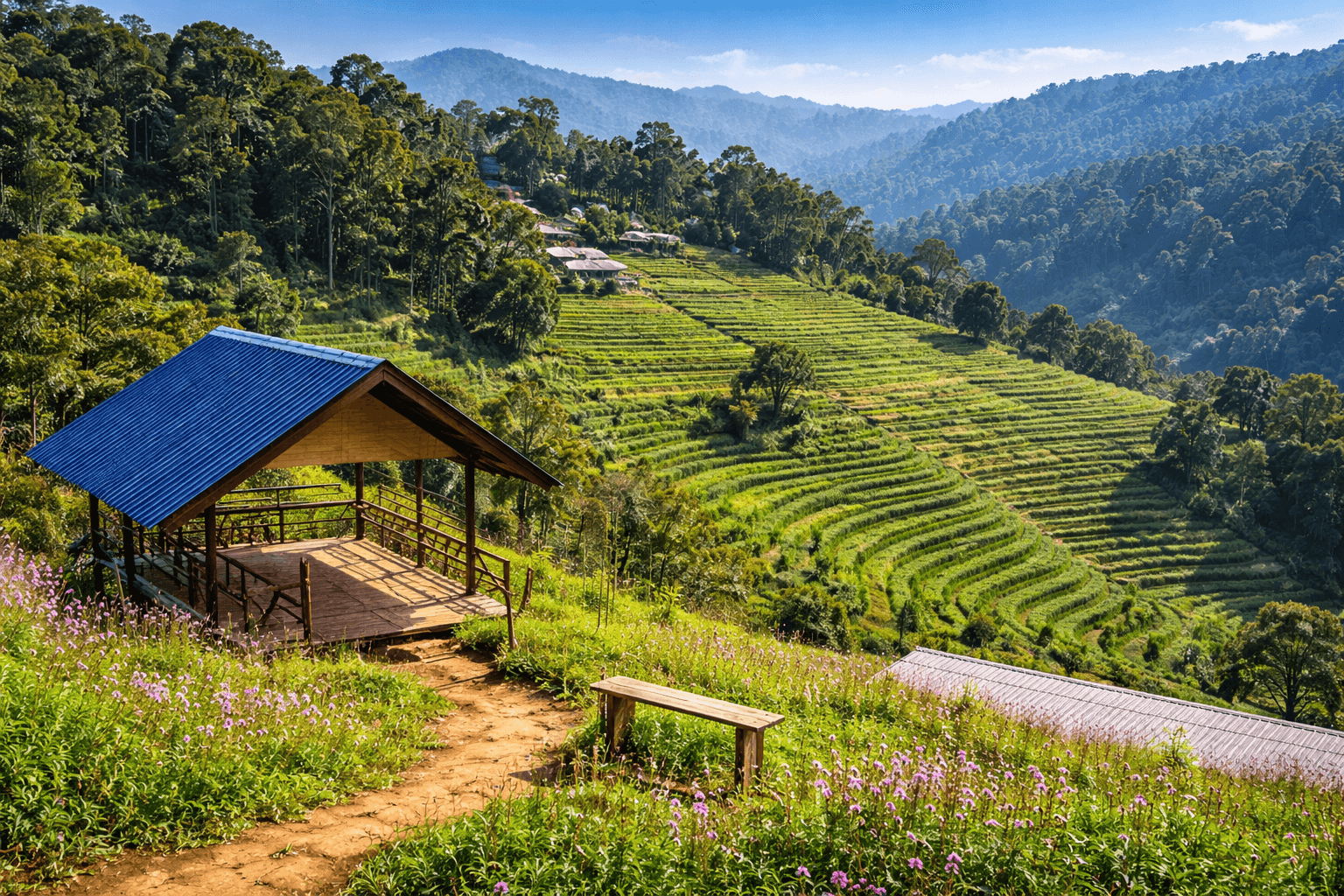
Leaving Chiang Mai northbound on Route 107 toward Mae Rim, the city behind you fades quickly. Traffic lessens and the air cools slightly as you near the mountains. From there, turning toward Monjam shifts the mood entirely. The road begins to curve through forested hills and agricultural terraces.
The Samoeng loop isn’t just a route, it’s a framework. It’s one of the most accessible ways to experience Chiang Mai off the beaten path, where the journey itself becomes the destination. You can either complete it in a single long ride, or break it into segments across multiple days. One direction continues through mountain passes before reconnecting toward Hang Dong, forming a satisfying circular return to the city. Another variation depends on how many scenic detours you choose along the way.
Strawberry farms line parts of the road, especially during cooler months. Small wooden stalls appear at bends in the highway, selling fresh fruit and smoothies. I rarely pass without stopping. These roadside pauses are part of what defines off the beaten path Chiang Mai, not grand attractions, but seemingly ordinary moments that feel grounded.
Waterfalls scatter throughout the region. Some require short forest treks, others sit directly off the roadside. Elephant sanctuaries, wild elephants, spectacular viewpoints, and rural temples decorate the hills, but the real reward is the ride itself, the undisturbed transitions between stops. If your travel style leans into movement and discovery, our Adventure travel style page explains the Off Path approach more clearly.
If you’re interested in exploring more of Northern Thailand, see our guide to Northern Thailand destinations.
Mon Jam (Mon Cham): Quick Information
Location: A hilltop viewpoint above Nong Hoi village in Mae Rim, roughly 40–45 minutes (~40km) from Chiang Mai via Route 107 and 1096
Opening Hours: Open 24 hours, though the most rewarding time is early morning (around 5–7am) for the sea of mist
Entrance Fee: Free to enter the general viewpoint area; individual flower gardens, strawberry picking, and activities like the hand-built “Formula Mong” go-karts charge small separate fees (roughly 40–50 THB each)
Best Time to Visit: November to February for the coolest weather and the strawberry and flower fields at their fullest; arrive at sunrise for the misty valley views
Highlights: Terraced strawberry and flower fields from the Nong Hoi Royal Project, panoramic mountain views at roughly 1,400m elevation, small local cafés, and the gravity-powered wooden go-karts
Good to know: This is a working agricultural site, not a polished resort, expect a rural, unhurried atmosphere with local Hmong and Karen communities living and farming in the area. It sits along the Samoeng Loop route, so it’s easy to combine with the wider loop, or visit as a standalone half-day trip from the city.
The Hidden Samoeng Hot Spring
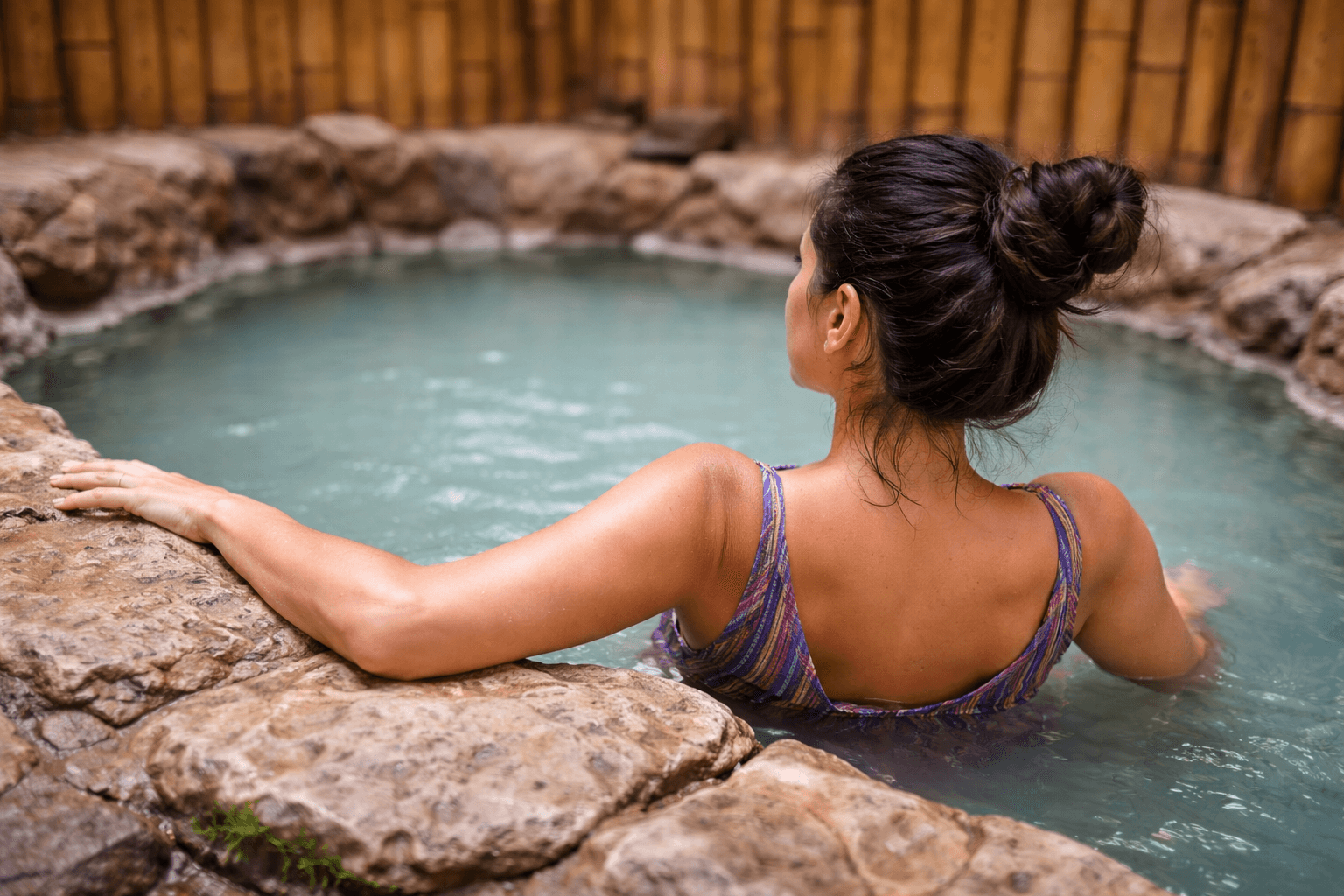
The hot spring I discovered through that rainy-day conversation lies beyond the usual Samoeng tourist loop. Instead of staying on the commonly traveled path, you veer off and climb further into the mountains, this is on the way to Mon Jam. As soon as you leave the 107 highway and begin ascending, at the very start of the mountain, just before the first gas station, you make a right.
As mentioned earlier, it was raining hard that day, one of those sudden mountain downpours that completely changes your morning. I had no choice but to pull over. Just ahead was a small Hmong souvenir shop, simple and quiet, tucked into the roadside. I stepped inside to wait it out, and the man running the shop welcomed me in without hesitation, offering shelter as the rain came down around us.
We started talking, nothing planned, just one of those natural exchanges that happen. It was there, in that moment, that he mentioned a hot spring nearby. Not something marked, not something most people pass through intentionally, just a place locals know, slightly off route, easy to miss unless someone points you toward it.
The road narrows from there. Nature takes over.
Along the way, you pass large lakes, orange farms set into hillsides, and villages where daily life continues as it always was, untouched by tourism. Temples appear without signage for foreign visitors. Children cycle along the roadside. Dogs nap in shaded patches of curvy roads.
Eventually, you reach the other side of Samoeng, a quiet town surrounded by layered mountain ridges. This is where some of the best Chiang Mai hidden gems reveal themselves. A final turn takes you down a broken road toward the hot spring. It’s wonderfully understated: no large tour buses, no souvenir stalls, just steaming natural pools surrounded by lush greenery. Cows often graze peacefully nearby, wandering through the open land as if they own the place.
I’ve visited many hot springs across Thailand, but this remains one of my favorites. It feels undiscovered in a genuine way, not marketed as “hidden,” but simply overlooked. In 2026, when many destinations feel over-documented, places like this still exist quietly. If hot springs and recovery are part of your travel identity, our Wellness travel style page connects the Off Path mindset to places like this.
Even many Chiang Mai locals who have lived here for decades have never heard of this place, let alone visited it.
If you’d like more details or help planning a visit, feel free to contact us.
3. East of Chiang Mai: Doi Saket as Sanctuary
Heading east on Route 118 toward Chiang Rai feels entirely different from the 107 corridor. The highway is broader, the terrain more open at first before rising into gentle hills. It’s a quieter transition out of the city, and one of the easiest ways to ease into Chiang Mai off the beaten path without committing to a long journey.
Doi Saket has become my sanctuary within Chiang Mai province. It lacks the density of tour groups found in more central attractions, and the rhythm here feels noticeably slower. Morning markets unfold without urgency, small cafés sit tucked into the greenery, and temples blend naturally into the landscape. Movement feels local rather than performative.
As you continue, the road winds gently through forest and farmland, revealing occasional unmarked viewpoints. Nothing feels staged, just a deep, steady sense of calm that makes this one of the best Chiang Mai hidden gems.
Doi Saket: Quick Information
Location: A district east of Chiang Mai on the road toward Chiang Rai, roughly 30–45 minutes from the Old City via Route 118 or Route 1006/121
Opening Hours: The area itself is accessible any time; individual attractions (temple, hot springs, dam, gardens) each keep their own hours
Entrance Fee: No general area fee; specific stops within Doi Saket charge their own small entry fees
Best Time to Visit: Year-round, but especially photogenic during Loy Krathong for local lantern releases at some of the district’s temples
Highlights: Wat Phra That Doi Saket’s hilltop views and sky walk, the district’s hot springs, Tweechol Botanic Garden, jungle trekking with waterfalls, and quiet rural villages largely untouched by mass tourism
Good to know: Doi Saket works well as a loosely connected day out rather than a single stop, temple, hot springs, dam, and countryside roads all sit close enough together to combine. A private driver or your own transport makes far more sense here than relying on songthaews, since the sights are spread across the district rather than clustered in one spot.
Doi Saket Hot Springs
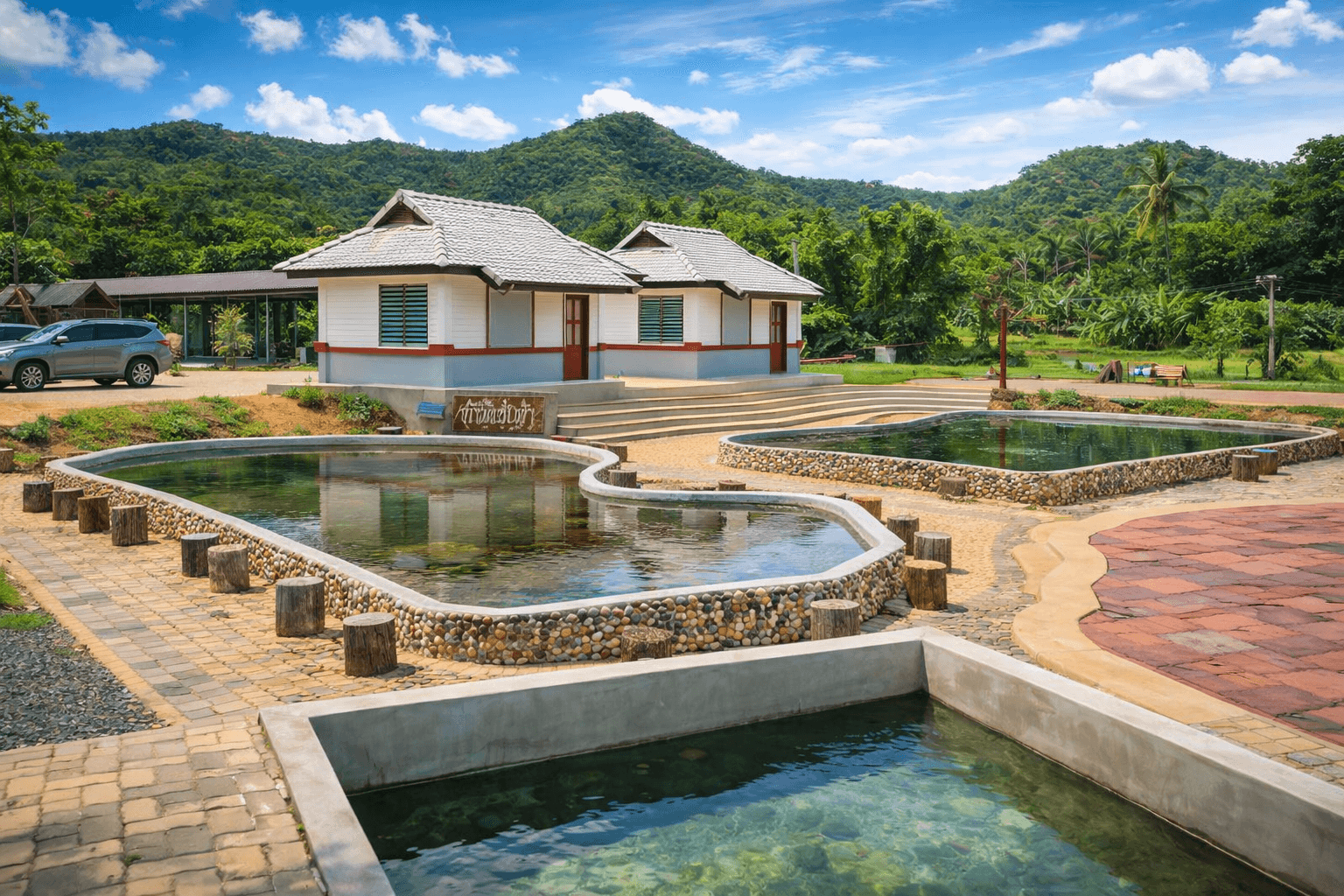
The Doi Saket hot springs sit just off the main highway, yet remain surprisingly calm, one of those places that still feels like one of Chiang Mai hidden gems despite how accessible it is. Unlike larger commercial complexes, the atmosphere here stays understated and local rather than overdeveloped.
There are two types of bathing rooms, older and newer, allowing you to choose between simplicity and a more updated level of comfort. It’s a small detail, but one that reflects the balance you often find when exploring Chiang Mai off the beaten path.
A small massage area operates nearby. A swimming pool provides an alternative to the hotter mineral baths. One well bubbles at an intensity too high for bathing, steam rising steadily into the air. The private rooms overlook surrounding mountains. Soaking there feels restorative rather than rushed. If you’re building a slower trip around recovery and well being, pair this guide with our Wellness travel style lens.
Doi Saket Hot Springs: Quick Information
Location: Pa Miang Subdistrict, Doi Saket District, roughly 45 minutes to 1 hour northeast of the Old City
Opening Hours: Daily, 8:00 AM – 6:00 PM
Entrance Fee: There’s a free public foot-bath pool by the road; the inner complex charges a small entry fee (foreigners ~100 THB, Thais ~40 THB), with private soaking rooms running roughly 65–100 THB per person for 30 minutes
Best Time to Visit: Weekday mornings for a quieter soak; pair it with a sunset stop at Wat Phra That Doi Saket for golden-hour valley views
Highlights: Natural mineral pools at varying temperatures, private soaking tubs, egg-boiling in the hot water, Thai massage on-site, and foot baths popular with local aunties
Good to know: Bring your own towel or expect a small rental fee (~10 THB). The area is genuinely rural, surrounded by rice fields, cows, and free-range chickens, so it’s a good pairing with Wat Phra That Doi Saket or a stop on the way back from Mae Kampong village rather than a standalone destination.
Wat Phra That Doi Saket
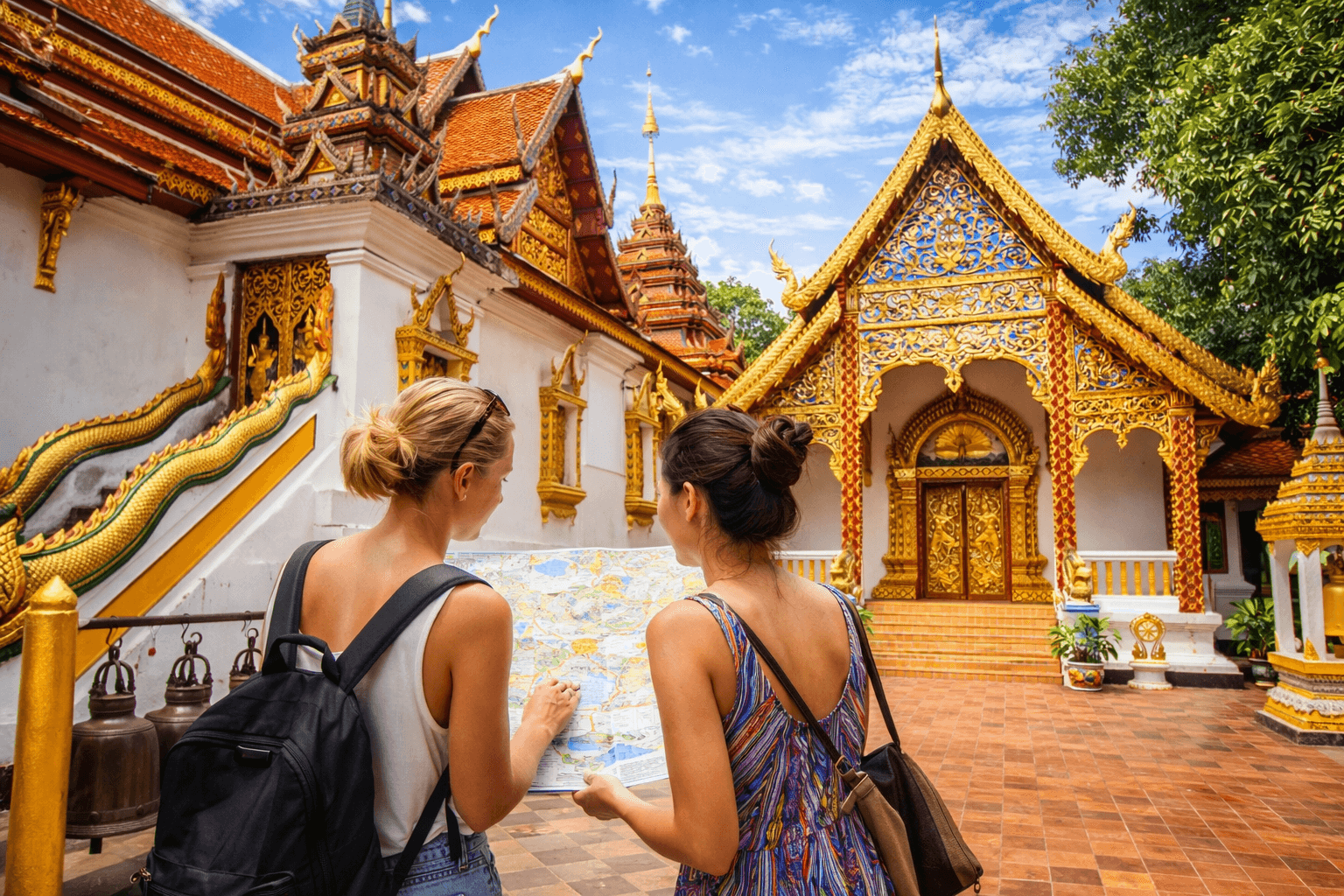
Wat Phra That Doi Saket rivals more famous temples in scale and artistry, yet remains firmly within Chiang Mai off the beaten path. Murals, intricate carvings, and expansive grounds give it a quiet depth that reveals itself slowly as you walk through.
Unlike Doi Suthep, buses rarely unload here. Visitors are mostly local families and long-time worshipers, giving the place a generational, grounded atmosphere that feels unhurried and authentic. This is one of the real Chiang Mai hidden gems, a quiet, reflective side of the city that most tourists never experience.
If you want a quick reference point, see the official background on Wat Phra That Doi Saket. If your trip is built around meaning, history, and quiet temples rather than highlight-chasing, our Cultural travel style page connects the dots.
Wat Phra That Doi Saket: Quick Information
Location: Atop Doi Saket mountain, roughly 30–40 minutes from Chiang Mai’s Old City via Route 1006 and 121
Opening Hours: Daily, generally dawn to dusk; go early morning for the quietest visit or sunset for the best valley light
Entrance Fee: Free to enter the temple grounds; the Indra’s Hanging Rock sky walk beside the temple has a small separate fee (~40 THB)
Best Time to Visit: Early morning to avoid crowds, or sunset for golden-hour views over the valley
Highlights: A hilltop golden chedi with sweeping countryside views, the sky walk, striking contemporary murals reinterpreting Buddhist storytelling, and a sacred Buddha footprint said to bring good luck
Good to know: You can drive straight up or park at the bottom and climb roughly 290–300 steps to the hilltop chedi. Unlike Doi Suthep, this temple rarely sees tour buses, giving it a noticeably calmer, more local atmosphere.
Mae Kuang Udom Thara Dam
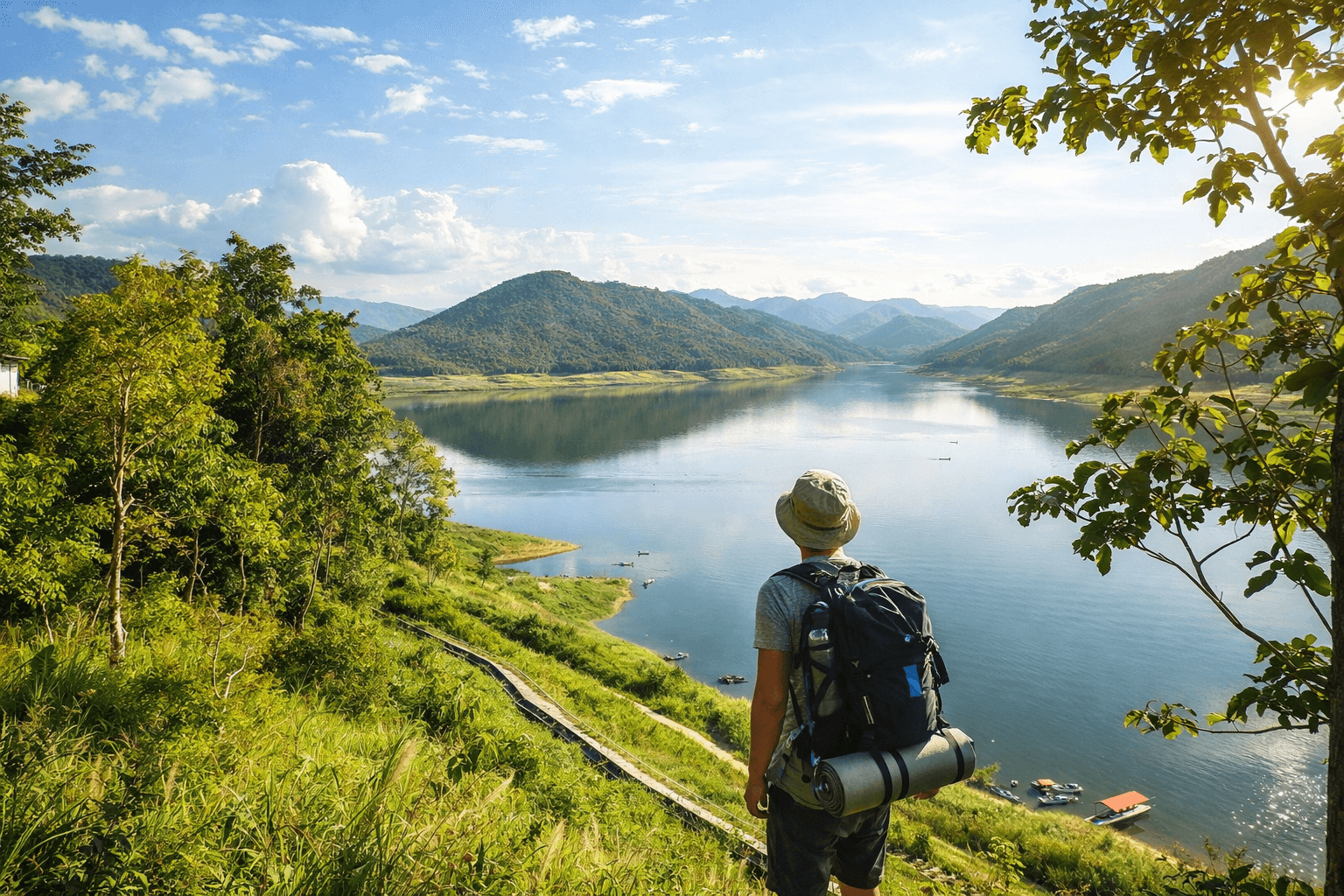
Not far from the temple lies Mae Kuang Udom Thara Dam, where wide water surfaces reflect the surrounding hills and the pace slows almost immediately, another easy extension into Chiang Mai off the beaten path. Small restaurants and local shops line certain stretches, offering simple meals and shaded seating without any sense of rush.
It’s the kind of place where you can spend an entire afternoon without structured plans, slow wandering, quiet sitting, and natural stops that feel completely unhurried. This is exactly what makes it one of the best Chiang Mai hidden gems, a genuine off the beaten path experience.
If you’re mapping days across the region, use the Thailand Trip Budget Calculator 2026 to estimate a calm day-trip cost (transport, meals, entry fees) without guessing.
Mae Kuang Udom Thara Dam: Quick Information
Location: Luang Nuea Subdistrict, Doi Saket District, roughly 30km / 45 minutes northeast of Chiang Mai via Route 118
Opening Hours: Daily, roughly 6:00 AM – 6:30 PM
Entrance Fee: Free
Best Time to Visit: Late rainy season (September–November) when the reservoir is fullest; early morning for mist over the water, or evening for the best light and photos
Highlights: A large earthen dam and reservoir with mountain views, the “Twin Bridges” suspension walkway popular with local couples (padlocks included), small lakeside restaurants, fishing, and trails for off-road or mountain biking
Good to know: The route in isn’t always well marked on Google Maps due to some road closures around the dam, once you reach the spillway, it’s often easier to just follow the road by sight rather than trust turn-by-turn directions. Pairs naturally with Tweechol Botanical Garden and Wat Phra That Doi Saket on the same drive out.
4. Mae Kampong & Mae On: The Roads That Keep Climbing
Mae Kampong
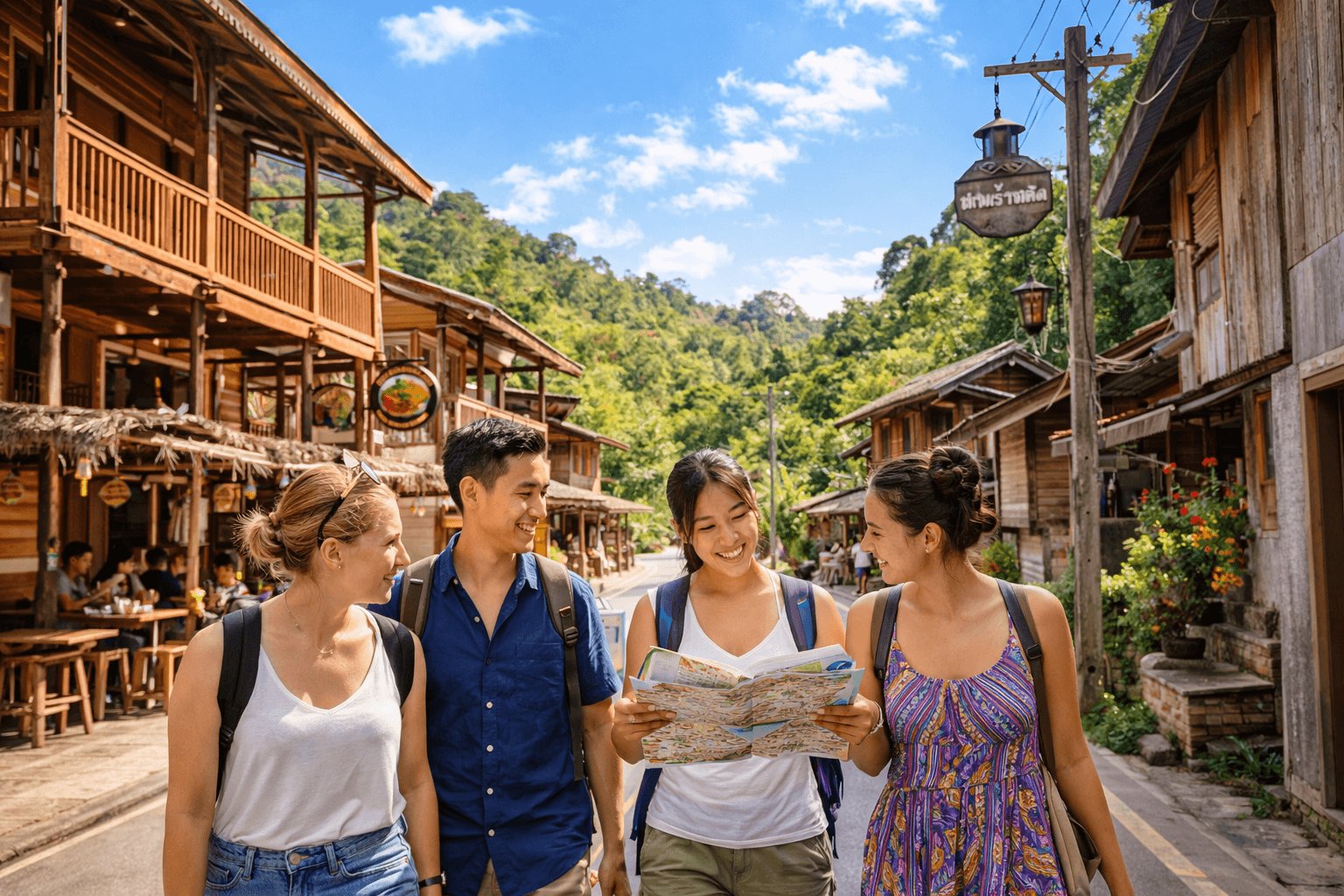
Mae Kampong has grown in visibility over recent years, but timing can still shape the experience. Before reaching the main viewpoint, you pass cafes built into hillsides, small waterfalls hidden behind foliage, and a village known for its coffee culture. The air feels cooler. Wooden houses cluster along narrow lanes.
Continuing upward eventually leads toward Lampang, where the road becomes more scenic and remote, an extension deeper into Chiang Mai off the beaten path. The ascent is gradual but fuel planning matters, as mountain roads don’t offer frequent stations.
Mae Kampong: Quick Information
Location: Mae On District, roughly 1 hour (~50km) southeast of Chiang Mai, sitting at about 1,300m elevation
Opening Hours: The village is accessible all day; individual cafés and viewpoints generally run 8:00 AM – 5:00 PM
Entrance Fee: Free to enter the village; homestays and some cafés have their own minimum spend or fees, tea tastings run roughly 50–100 THB
Best Time to Visit: Weekday mornings before 9am for mist through the canopy and a quiet village; weekends between 11am–2pm bring the heaviest day-tripper crowds
Highlights: A century-old village built along a fast-running stream, traditional wooden homes on stilts, a 7-tier waterfall, mountain coffee terraces, fermented tea (miang) tasting, and hillside cafés with panoramic views
Good to know: Google Maps typically drops you at the village’s main arrival point, but there’s more to see both before and after it, worth exploring beyond where the pin lands. Park at the temple near the entrance to avoid congestion further in. Book homestays well ahead for weekends and the cool season (November–February), beds fill up fast.
Mae On
Mae On is actually where my most recent trip to Chiang Mai ended up taking me. There’s something about riding out this direction that feels different from the rest of the Doi Saket corridor, the roads roll rather than climb, winding gently through hills that never quite become mountains but still give you that sense of leaving the city fully behind.
What surprised me most was how charming the area feels without trying to. Small cafés appear at random along the route, tucked into bends in the road or perched on a slope with a view over the valley, the kind of places you’d never find searching online, only by actually being out there and noticing them. I’ve stopped at more than a few just because the setting pulled me in, and every single time the tea’s been genuinely good, not an afterthought to the view.
There’s also a surprisingly pleasant residential pocket in Mae On that I wasn’t expecting, quiet streets, well-kept homes, a sense that people actually live and settle here rather than just pass through. It gave the whole area a grounded, lived-in feeling that a lot of more “touristy” mountain stops around Chiang Mai lack. Riding through it, I found myself thinking this could genuinely be a place to spend a longer stretch of time, not just an afternoon detour.
If Doi Saket is where I go for temples and hot springs, Mae On has become where I go simply to ride and let the road decide the day. No fixed plan, no checklist, just rolling hills, good coffee, and the occasional surprise around a bend.
Mae On: Quick Information
Location: A district roughly 30–40km east of Chiang Mai city, bordering San Kamphaeng and stretching up toward Mae Kampong
Opening Hours: The area itself is accessible any time; individual attractions (Muang On Cave, hot springs, cafés) keep their own hours
Entrance Fee: No general area fee; specific stops charge their own small entry fees
Best Time to Visit: Cool season (November–February) for the most comfortable riding weather through the rolling hills
Highlights: Gently rolling mountain roads, small unmarked cafés tucked into bends and slopes, Muang On Cave, San Kamphaeng Hot Springs, and a surprisingly pleasant residential pocket that feels genuinely lived-in rather than touristy
Good to know: Unlike the steeper climbs around Samoeng or Doi Suthep, Mae On’s roads roll rather than climb, making it an easy, relaxed ride. This is a destination best explored without a fixed plan, the best stops here tend to be the ones you stumble onto rather than the ones you search for in advance.
Mae On Caves
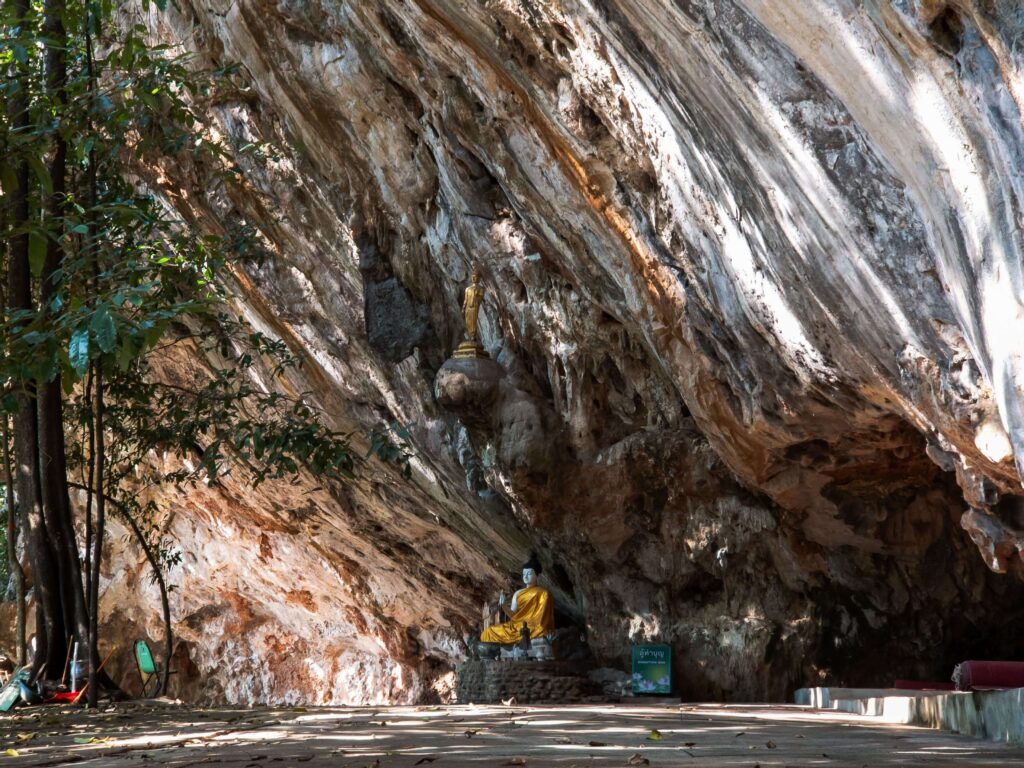
I visited Muang On Cave a few years back, and even though I was staying just nearby on this most recent trip, I didn’t actually make it back this time, only two nights in the Mae On area, and the days filled up faster than I expected. Still, it’s stayed with me enough that I want to include it here, since it’s genuinely one of the more sacred, quietly moving spots in the region.
The first time I went, I happened to arrive at the exact same moment a songthaew full of monks pulled up. Watching them file out and make their way up the naga staircase ahead of me completely changed the tone of the visit. It stopped feeling like a tourist stop and started feeling like something I was fortunate enough to witness, a genuine moment of pilgrimage rather than sightseeing.
I followed a respectful distance behind, and something about entering the cave right after them made the whole space feel heavier with meaning than it probably would have otherwise.
Inside, it’s exactly the kind of place that earns the word sacred, large caverns, an enormous stalagmite, a reclining Buddha resting in the lower chamber, all lit just enough to feel reverent rather than staged.
One practical note worth mentioning: the air inside gets genuinely humid, noticeably thick compared to outside, so if you deal with sinus issues or find humidity uncomfortable, it’s worth pacing yourself or keeping the visit relatively brief. It’s not an issue for most people, but it’s the kind of detail I wish someone had mentioned to me before my first visit.
I fully intend to go back on my next trip through Mae On. Some places you can tell are worth returning to even after just one visit, and this is one of them.
Muang On Cave: Quick Information
Location: San Kamphaeng/Mae On District, roughly 30km east of Chiang Mai, near San Kamphaeng Hot Springs
Opening Hours: Daily, roughly 8:00 AM – 5:00 PM
Entrance Fee: 20–30 THB (same for Thais and foreigners), plus a small parking fee (~10 THB); torch rental available for around 20 THB if needed
Best Time to Visit: Weekday mornings for a quieter, cooler visit before the midday climb gets hot
Highlights: A well-lit cavern with a 30-foot reclining Buddha, colorful shrine lighting, dramatic stalactites and stalagmites, and a legend involving the Buddha and the Naga serpent king tied to the site’s origin
Good to know: Reaching the entrance means climbing roughly 150–180 steps up a naga staircase, followed by steep stairs down into the cave itself, comfortable shoes are essential. The air inside runs noticeably humid and a bit stale rather than cool, worth pacing yourself if you’re sensitive to sinus issues.
5. Mae Rim: Where I’d Build a Home
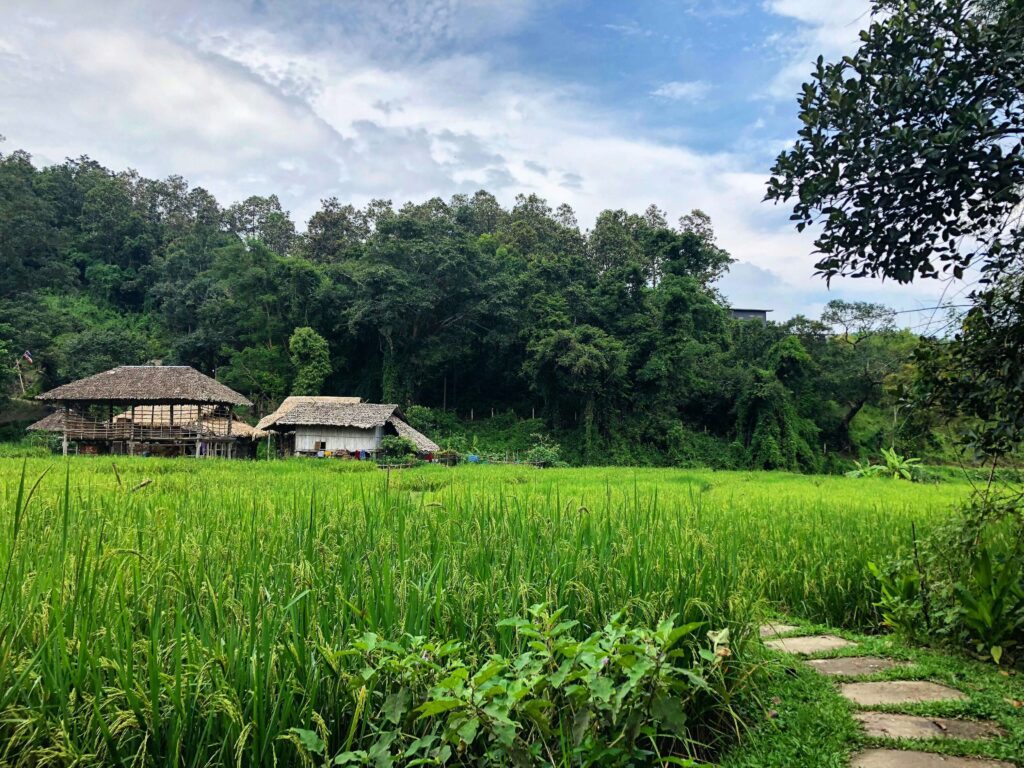
If I ever chose to settle permanently in Chiang Mai province, Mae Rim would be a genuinely strong contender, and it’s not a decision I’ve taken lightly given how much of this region I’ve actually ridden through over the years. Located north along the 107 corridor toward Chiang Dao, Mae Rim strikes a balance I haven’t quite found anywhere else nearby: close enough to the city that a grocery run, a hospital visit, or a decent coffee shop is never more than a short ride away, yet far enough out that the pace of life genuinely shifts the moment you turn off the main road.
This area holds some of the best Chiang Mai hidden gems I’ve come across, ethical elephant sanctuaries tucked into the hills, scenic waterfalls that rarely see a crowd on a weekday, forest parks that feel far larger and quieter than their proximity to the city would suggest, and peaceful viewpoints that most visitors drive straight past on their way to somewhere more famous.
What makes Mae Rim different from some of the more remote stretches of this guide is that none of this comes at the cost of convenience. You can spend your morning hiking to a waterfall and still be back in time for lunch at a proper restaurant, or head out for an afternoon at a sanctuary and be home before dark without a long, exhausting drive.
It’s this combination, immersion without isolation, that keeps pulling my thoughts back to Mae Rim whenever I imagine a longer-term future here. It’s not the loudest or most talked-about part of Chiang Mai province, but it might be the most livable.
It’s ideal for day trips, longer stays, or gradual exploration. Continuing further north leads into deeper mountain territory, explored in more detail in our Chiang Dao destination page. Mae Rim feels like a midpoint, not remote, yet distinctly separate from the city’s density.
Mae Rim: Quick Information
Location: North of Chiang Mai city along Route 107, roughly 30 minutes away, sitting at the foot of Doi Suthep on the road toward Samoeng
Opening Hours: The district is accessible anytime; individual attractions (waterfalls, sanctuaries, gardens) each keep their own hours
Entrance Fee: No general area fee; specific attractions charge separately (ethical elephant sanctuaries typically run around 2,000–3,000 THB for a half or full-day visit, Mae Sa Waterfall and most gardens charge a small entry fee)
Best Time to Visit: Cool season (November–February) for the most comfortable conditions; avoid March–April due to heat and burning-season air quality
Highlights: Ethical elephant sanctuaries, the ten-tiered Mae Sa Waterfall, Queen Sirikit Botanical Garden, hill tribe villages, orchid and butterfly farms, and easy access up toward Mon Jam and the Samoeng Loop
Good to know: If you’re choosing an elephant sanctuary in this area, look specifically for “no-riding, no-show” facilities, this has become the standard phrase reputable, ethical sanctuaries use in northern Thailand. Mae Rim also makes a genuinely comfortable base for a longer stay, close enough to the city for daily conveniences, but immersed enough to feel like real mountain living. If you’d like a trip built around more comfortable stays, see our Chiang Mai luxury tours.
6. Doi Suthep: The Layer Most Tourists Miss
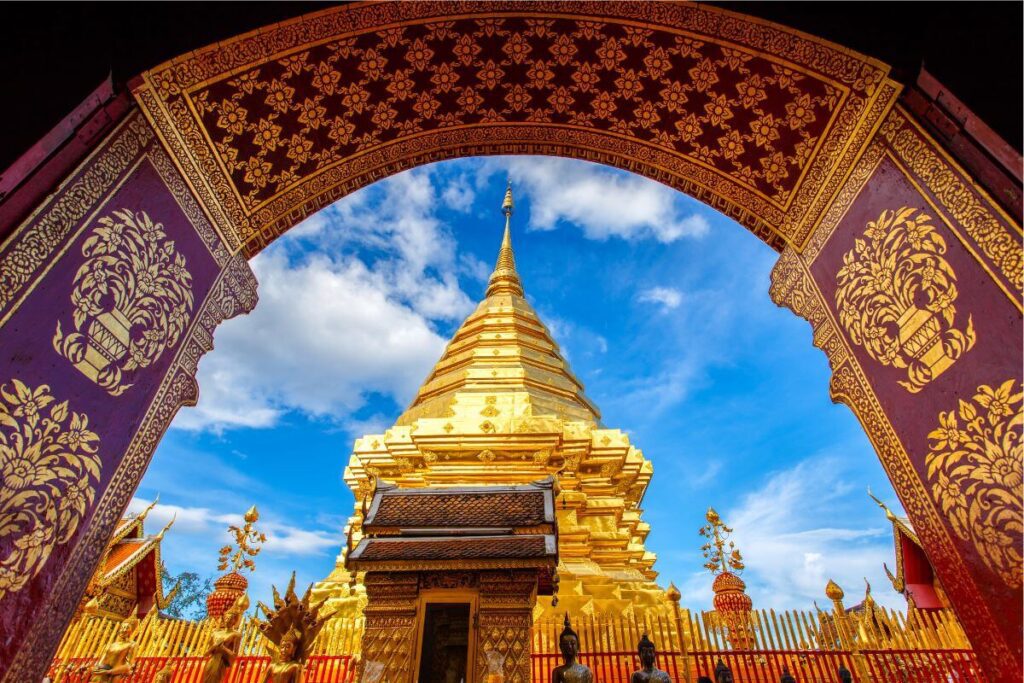
Doi Suthep’s main temple is iconic, its beauty is undeniable. However, its popularity often overshadows the quieter gems that make the entire mountain so special.
Doi Suthep is my default whenever I can’t think of anywhere else to go. Right next to town, it’s the closest thing I have to an automatic reset button. Back when I was working out of a coworking space nearby, any time I felt stressed or just needed a break from my screen, I’d literally hop on my bike and ride all the way up to the temple, then simply come back down. No plan, no reason beyond needing the ride. I did this three times a week, sometimes more.
Even now, whenever I’m back visiting Chiang Mai and I’ve only got a few hours left on my rental before my flight, Doi Suthep is where I go. It’s never once let me down. Always peaceful, always exactly what I needed, whether I’ve got a full afternoon or barely ninety minutes to spare.
What’s funny is when I’ve mentioned this to actual Chiang Mai locals, more than a few have told me the last time they went up was a decade ago. Meanwhile I’m up there three or four times a week whenever I’m in town. It’s strange, this mountain sits right on the edge of the city, practically in everyone’s backyard, and yet it somehow gets treated like a once-in-a-lifetime tourist stop rather than what it actually is: one of the easiest, most reliable places to clear your head in all of Chiang Mai.
Most visitors treat Doi Suthep as a single stop: go up, see the temple, and head back down. But the mountain itself holds some of the best Chiang Mai hidden gems, quiet trails, smaller temples, peaceful viewpoints, and local spots that very few people explore. If you give it more time and venture slightly off the main path, you’ll discover a completely different, far more personal and authentic side of Doi Suthep, the version I keep coming back to, over and over, for exactly that reason.
Doi Suthep (Mountain): Quick Information
Location: Doi Suthep-Pui National Park, right on the western edge of Chiang Mai city, roughly 14–15km from the Old City to the temple
Opening Hours: The national park and mountain roads are accessible daily, generally dawn to dusk for hiking; the park entrance fee counter is at the Huay Kaeo checkpoint about 1km above the zoo
Entrance Fee: 100 THB national park fee for foreigners (paid at the Huay Kaeo checkpoint), separate from the temple’s own entrance fee further up
Best Time to Visit: Early morning for cooler hiking temperatures and quieter roads before day-trip traffic builds
Highlights: Dozens of hiking and mountain biking trails of varying difficulty, waterfalls and viewpoints along the way up (Wang Bua Baan, Monthatarn), the Monk’s Trail to Wat Pha Lat, and further up, Bhubing Palace and Doi Pui
Good to know: You don’t need a guide to explore most of the mountain, the road up to the temple and several trails are easy to navigate independently by bike, car, or on foot. Longer hikes to Doi Pui or the hill tribe villages beyond it are better done with a guide, and dress warmly if riding up by scooter, it gets noticeably colder near the summit than in the city below.
Wat Pha Lat
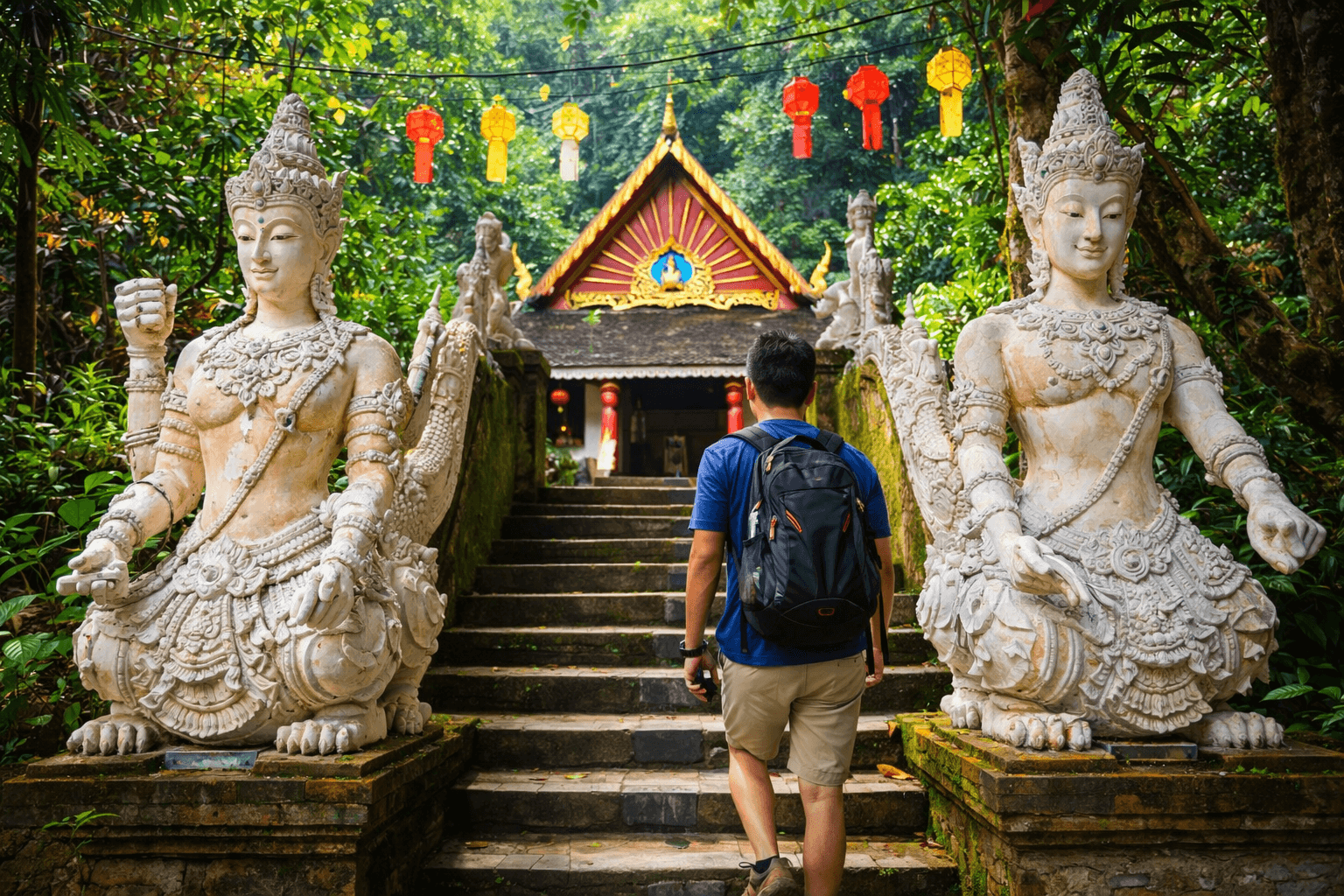
Wat Pha Lat sits quietly along a forested trail below the summit of Doi Suthep, and reaching it on foot changes the entire experience. The Monk’s Trail winds gradually uphill through dense greenery, with the sound of running water accompanying parts of the climb. Arriving this way creates a natural transition, from city noise to shaded stillness.
The temple complex blends into the forest rather than dominating it. Moss-covered stone structures, small shrines tucked into corners, and wooden meditation spaces create an atmosphere that feels contemplative rather than ceremonial, at least, that’s how I remember it.
Honestly, it’s changed a lot even in the past few years. Not long ago, whenever I went, there’d only be a handful of people around, and I could easily find a sala or a small shaded corner to sit and meditate without anyone else nearby. Lately it seems to always be packed. Dozens of tour SUVs now line up out front, and the quiet I used to rely on here has gotten harder to find, especially later in the morning once the day trips arrive.
Wat Pha Lat is no longer the understated secret it once was, and I say that with a bit of sadness, but it’s still one of the best Chiang Mai hidden gems worth making time for. If you want anything close to the atmosphere I’m describing, go early, ideally before 8am, before the crowds and the parking lot fill up. For background, see Wat Pha Lat, and if temples and history are central to your trip, our Cultural travel style page is built for this.
Wat Pha Lat: Quick Information
Location: Doi Suthep foothills, reached via the Monk’s Trail starting behind Chiang Mai Zoo (~15–20 min from the Old City)
Opening Hours: Daily, roughly 6:00 AM – 6:00 PM
Entrance Fee: Wat Pha Lat itself is free to enter; the Monk’s Trail leading up to it now has a 100 THB access fee (introduced October 2025), collected at a ticket booth near the trailhead
Best Time to Visit: Early morning, ideally before 8am, to catch the monks’ chants, beat the heat, and enjoy the temple with fewer people around
Highlights: A jungle-set forest temple with a restored Burmese-style riverside pavilion, moss-covered statues, small waterfalls, and a genuinely peaceful stop before the steeper climb to Doi Suthep
Hmong Village & Bhubing Palace
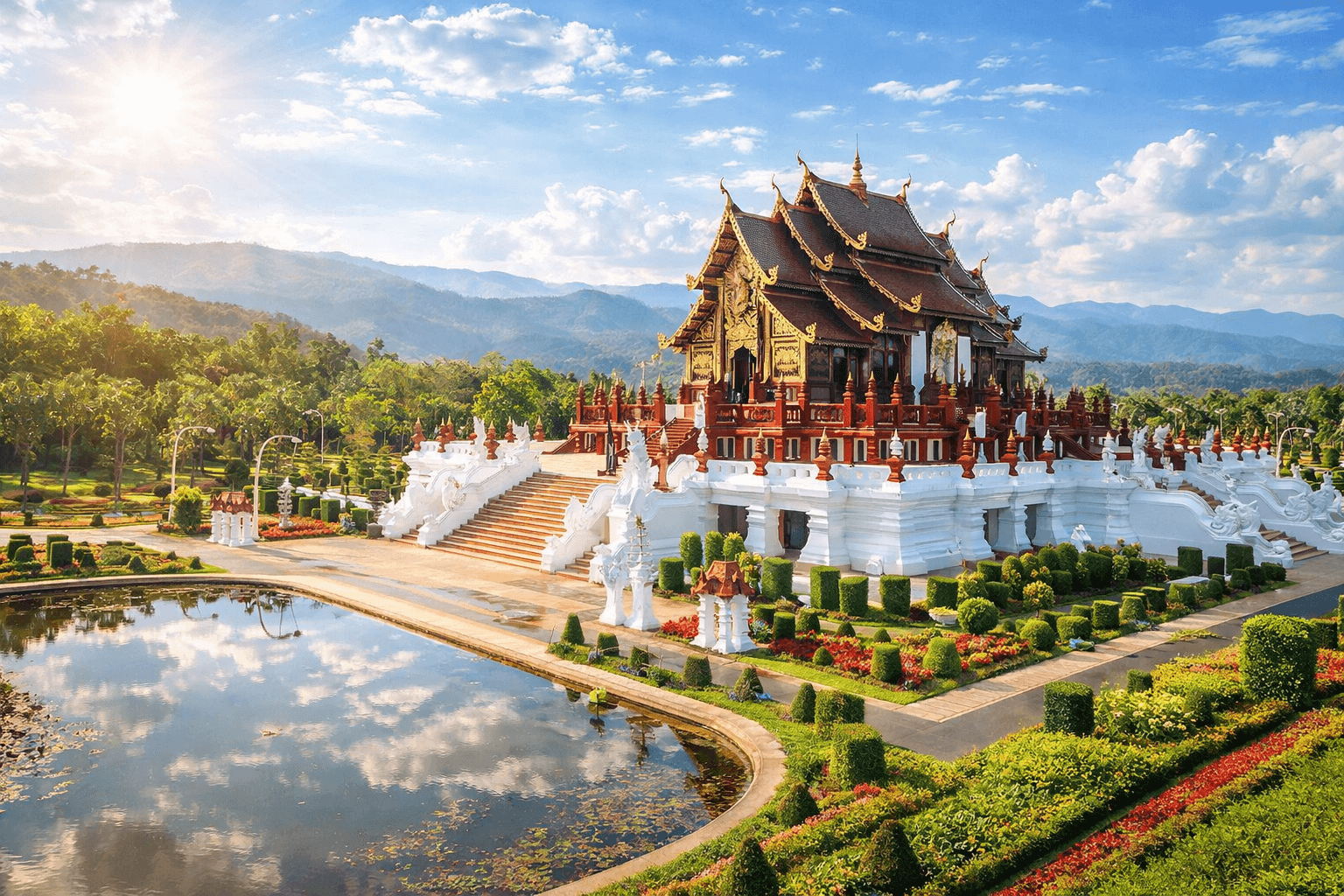
Continuing past the main temple along the mountain road reveals additional layers that many visitors skip, another step deeper into Chiang Mai off the beaten path. The Hmong Village offers insight into the cultural heritage of hill communities in the region, with small shops selling handmade textiles, silverwork, and locally grown produce.
While some areas feel slightly commercial, it still offers a genuine glimpse into a different cultural rhythm compared to the crowds below, one that reflects everyday local life. This is part of what makes it one of the more interesting Chiang Mai hidden gems in the area.
Further along sits Bhubing Palace, the royal winter residence. The grounds are carefully maintained, with landscaped gardens, seasonal flowers, and mountain views stretching outward. The palace enforces a modest dress code, long pants and covered shoulders are advisable, which naturally filters out some casual visitors. For reference, see Bhubing Palace.
Bhubing Palace & Doi Pui Hmong Village: Quick Information
Bhubing Palace
Location: On the slopes of Doi Suthep, about 6km past Wat Phra That Doi Suthep, within Doi Suthep-Pui National Park
Opening Hours: Daily, 8:30 AM – 4:30 PM (ticket office closes for a midday break, roughly 11:30 AM–1:00 PM); last tickets sold ~3:30 PM
Entrance Fee: 50 THB for foreign adults, 10–20 THB for children
Best Time to Visit: Early morning right at opening to avoid crowds; November–February for the rose garden in full bloom
Highlights: The royal family’s winter residence gardens, roses, hydrangeas, and orchids thriving in the cooler mountain climate, plus wooden cabins and a reservoir
Doi Pui Hmong Village
Location: Just 4km from Wat Phra That Doi Suthep, further up the mountain within the national park
Opening Hours: Daily, roughly 8:00 AM – 5:00 PM
Entrance Fee: Around 10 THB per person; a red songthaew ride up from the temple costs roughly 40 THB
Best Time to Visit: Morning, paired with Bhubing Palace and Doi Suthep on the same route up the mountain
Highlights: Handmade Hmong textiles and silver jewelry, a small history museum, and (in season) striking poppy fields
Good to know: Dress modestly for Bhubing Palace specifically, shoulders and knees covered, no sandals with ankle straps, or you’ll be handed a cover-up at the gate. Both sit on the same mountain road as Doi Suthep and Wat Pha Lat, so they’re almost always visited together as one longer day out.
Doi Pui Peak
Continuing upward beyond the more commonly visited stops brings you to Doi Pui, the highest point in the Doi Suthep–Pui range, where Chiang Mai off the beaten path begins to feel more pronounced. Fewer travelers make it this far, and the shift is noticeable.
The road narrows, curves tighten, and traffic thins out quickly. By the time you reach the upper sections, it feels like you’ve left the main attraction behind and entered one of the best Chiang Mai hidden gems, a much quieter, more peaceful side of Doi Pui Peak.
At the peak, a viewpoint opens across layered mountain ridges stretching into the distance. On clear days, visibility extends far beyond the immediate valley. The air is cooler here, sometimes surprisingly so, even when Chiang Mai city feels warm. Wind can pick up quickly, and temperatures drop with elevation, so a light layer is useful.
Beyond the viewpoint, the landscape shifts again. Small flower gardens, agricultural plots, and trekking routes branch outward into quieter terrain. Further still, you begin to encounter legitimate Hmong villages, not the curated market-style stops, but lived-in communities where daily life unfolds without display. Wooden houses, vegetable patches, livestock, and children playing along the villages give the area an authentic feel. These are not places designed as attractions; they simply exist as part of the mountain ecosystem.
Riding up to Doi Pui reframes the entire Doi Suthep experience. What begins as a crowded temple visit can gradually transform into a broader mountain exploration, one defined by elevation, space, and a more authentic connection to the surrounding communities. If you travel for discovery, movement, and “what’s next,” our Adventure travel style page matches this exact mindset.
Doi Pui Peak: Quick Information
Location: Doi Suthep-Pui National Park, the taller of the mountain’s twin summits at 1,685m elevation, just past Bhubing Palace and the Hmong village
Opening Hours: Accessible daily, best visited during daylight hours for safety on the mountain roads and trails
Entrance Fee: Covered under the national park’s foreigner entry fee; a songthaew from Wat Phra That Doi Suthep to the summit area runs roughly 200 THB each way (be prepared to negotiate)
Best Time to Visit: June through February for the best hiking conditions; avoid March–May, which coincides with smoky burning season in the region
Highlights: Cooler mountain air even when the city below feels warm, quiet hiking trails through bamboo and pine forest, layered mountain-ridge views, and genuine Hmong communities living beyond the market-style village stop
Good to know: Doi Pui is technically the higher of the two peaks (1,685m vs. Doi Suthep’s 1,676m), though the temple’s name is what stuck for the whole mountain. Traffic thins out noticeably past Bhubing Palace, this is where the crowds from the temple largely disappear, and the road starts to feel like a genuine mountain drive rather than a tourist route.
7. The Quiet Side of Sticky Waterfalls
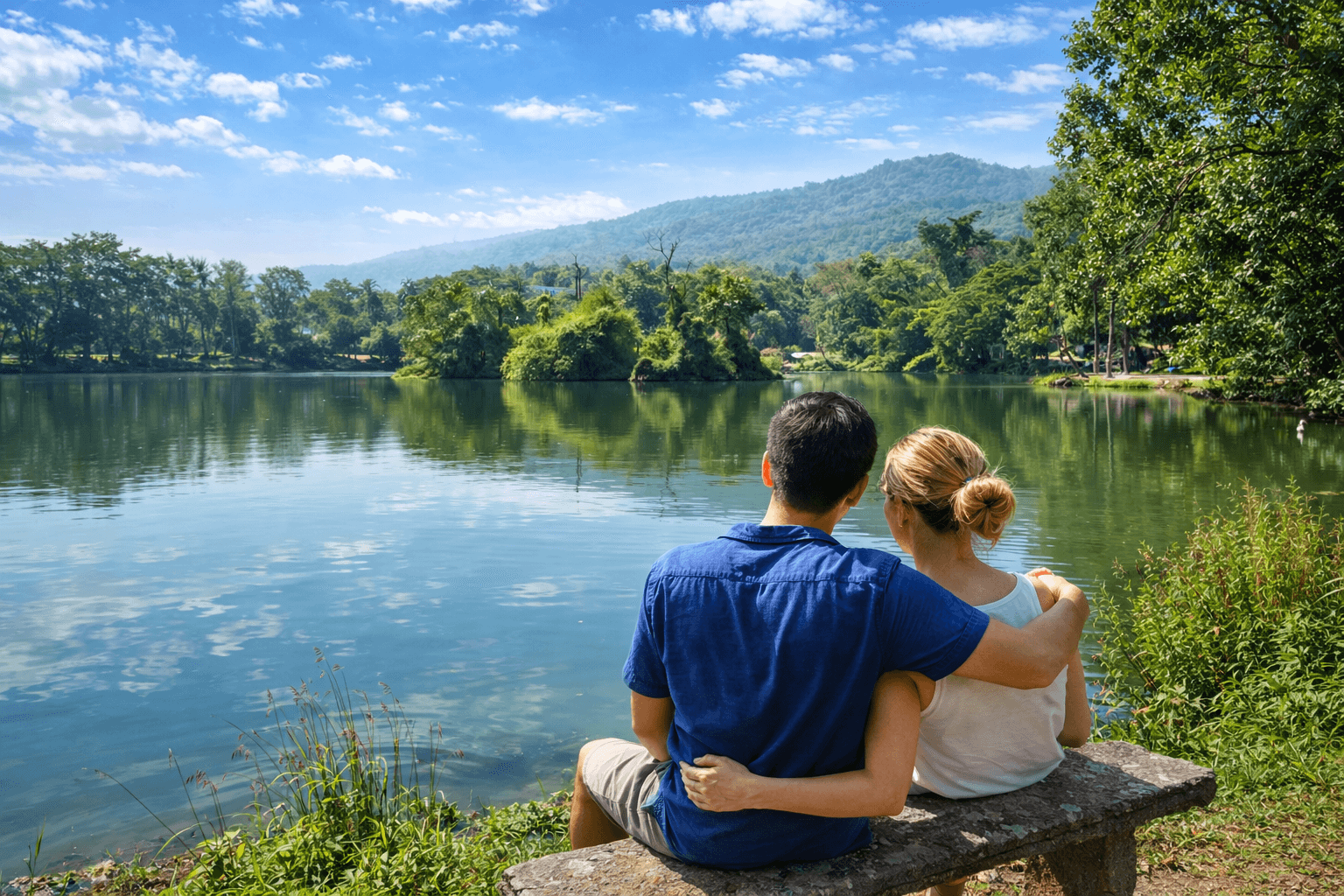
Sticky Waterfalls themselves are no longer a hidden gem. They’re well-known, frequently included in day tours, and can feel lively by mid-morning. The limestone surface is unique and fun to climb, but the surrounding area holds a quieter layer that many people overlook.
Mae Ngat Dam sits close enough to pair easily with the waterfalls, yet it operates at a completely different pace. The water stretches wide and still, bordered by low hills and patches of forest. There’s no structured activity demanding attention, no crowds gathering at a single focal point. Instead, the space feels open and breathable.
You can park for the afternoon and walk along the water’s edge, sit under shaded trees, or simply watch the way the light moves across the surface. Late afternoon is particularly peaceful, when the air cools slightly and reflections settle into the water. A small restaurant nearby makes it easy to stay longer, simple Thai dishes, cold drinks, and shaded seating overlooking the reservoir.
If you treat Sticky Waterfalls as a quick photo stop, you’ll likely leave with just that memory. But if you allow the surrounding region to shape the day, pairing activity with pause, the entire experience changes. The reservoir, the quieter roads, and the open sky above create a softer rhythm that makes this one of the best Chiang Mai hidden gems, where the atmosphere lingers long after you leave.
Do You Need a Ride to Explore Chiang Mai Hidden Gems?
Most of the places in this guide are not easily accessible by public transport. While renting a ride gives you the greatest freedom, many travelers prefer a more comfortable experience.
You can always contact us via WhatsApp, we’ll arrange a private car and a knowledgeable local guide to make the whole trip comfortable, easy, and fully flexible according to your pace. See how our Chiang Mai custom tours work.
Mae Ngat Dam: Quick Information
Location: Mae Taeng District, within Sri Lanna National Park, roughly 50km (about 1.5 hours) north of Chiang Mai city via Highway 107
Opening Hours: Accessible daily; no strict posted hours, but best visited during daylight for boat access and safety on the water
Entrance Fee: Around 20 THB park entry, plus a small transport/pier fee; a long-tail boat charter to the floating restaurants and huts runs roughly 500–1,000 THB, split among your group
Best Time to Visit: Morning to early afternoon for calmer water and better boat availability; cool season (November–February) for the most comfortable weather
Highlights: Floating restaurants and simple bamboo bungalows on the water, swimming and kayaking, a giant rain tree rising out of the lake, and mountain views across the reservoir
Good to know: If you’re just visiting the restaurants near the entrance rather than trekking further into the national park, there’s often no entry fee at all, just the boat charter cost if you want to reach the floating huts. Pairs naturally with a stop at Sticky Waterfalls (Bua Tong), which sits along the same general route north of the city.
8. Baan Tawai, One of Chiang Mai’s Quieter Craft Hidden Gems
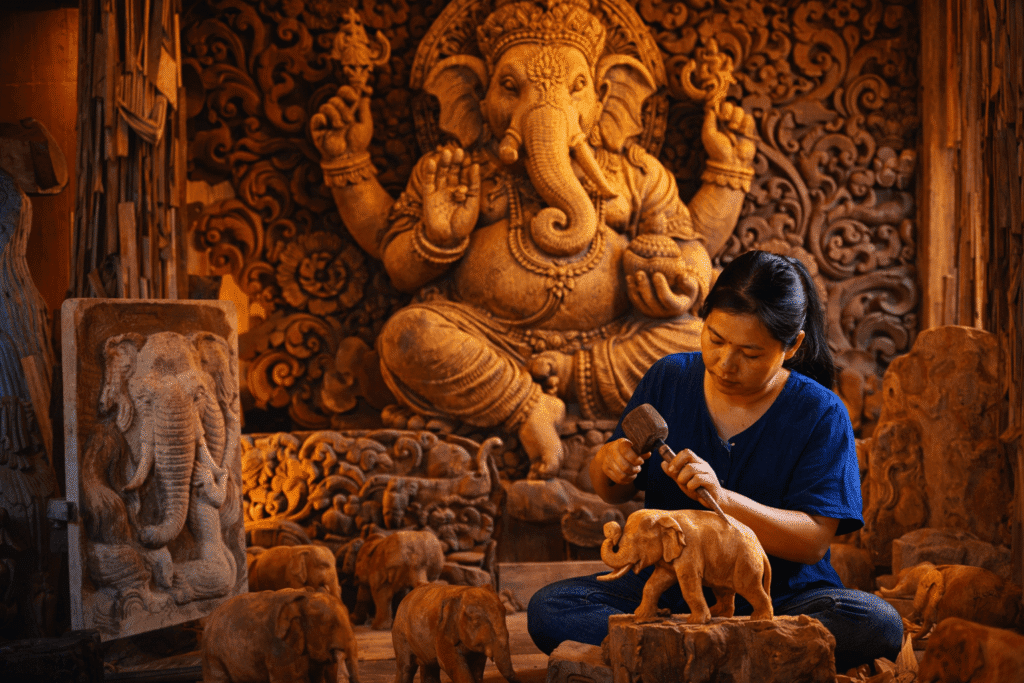
What most visitors don’t realize is that Baan Tawai isn’t just a quiet craft village to browse through for an hour, it’s actually one of the real supply sources behind a huge chunk of what you see sold across Chiang Mai. A significant amount of the wooden crafts, carvings, and furniture pieces you’ll find at the Saturday Walking Street, the Sunday Walking Street, and the Night Bazaar are actually sourced from here, made by the same artisans working in these small home workshops, then sold on at a markup once they reach the tourist-heavy markets in the city.
It doesn’t stop at Chiang Mai either. Vendors and shop owners from as far as Bangkok make regular trips out here to buy wholesale, restocking their own stores with pieces that started their life in this one village. In that sense, Baan Tawai functions almost like a hidden production hub for Northern Thailand’s entire wood and handicraft trade, most of it happening quietly, without any of the fanfare of the markets it actually supplies.
The scale goes even further than domestic trade. A fair amount of what’s made here gets exported internationally, including to Europe, where demand for handcrafted Thai woodwork and furniture has remained steady for years. There are genuine businesses built entirely around this village, buyers, exporters, and craftsmen who’ve turned Baan Tawai into a real economic engine rather than just a tourist stop.
That’s really what makes this one of the more important hidden gems on this whole list. It’s not hidden because it’s remote or hard to find, it’s hidden because almost nobody visiting Chiang Mai realizes that the very souvenirs they’re buying somewhere else in the city likely started right here, carved by hand in a small workshop most tourists will never think to visit.
Baan Tawai (Woodcarving Village): Quick Information
Location: Hang Dong District, about 12km southwest of Chiang Mai city, just off Hang Dong Road
Opening Hours: Daily, roughly 9:00 AM – 5:00 PM (some workshops open earlier or close later)
Entrance Fee: Free
Best Time to Visit: Weekday mornings, when workshops are active and you’ll see artisans actually working rather than just browsing finished pieces
Highlights: Hand-carved wooden furniture, sculptures, lacquerware, and decorative pieces, made and sold directly by the artisans who craft them
Good to know: This is one of the real supply sources behind Chiang Mai’s night markets, and even shops as far as Bangkok, with a fair amount of the wood and craft goods you’ll see at the Saturday Walking Street, Sunday Walking Street, and Night Bazaar actually originating here, and exported as far as Europe. Prices here are noticeably closer to wholesale than what you’ll pay for the same pieces once they reach the tourist markets in town.
Map: Chiang Mai Hidden Gems & Quiet Spots
This map highlights some of the places mentioned in this guide so you can plan a route, save pins, and build calm Chiang Mai days without turning the trip into a rigid itinerary.
Prefer a quick chat?
Message us directly on WhatsApp
If you already have an idea of your trip, send us a message, we’ll guide you through the best options for your travel style.
Chat on WhatsAppor
[email protected]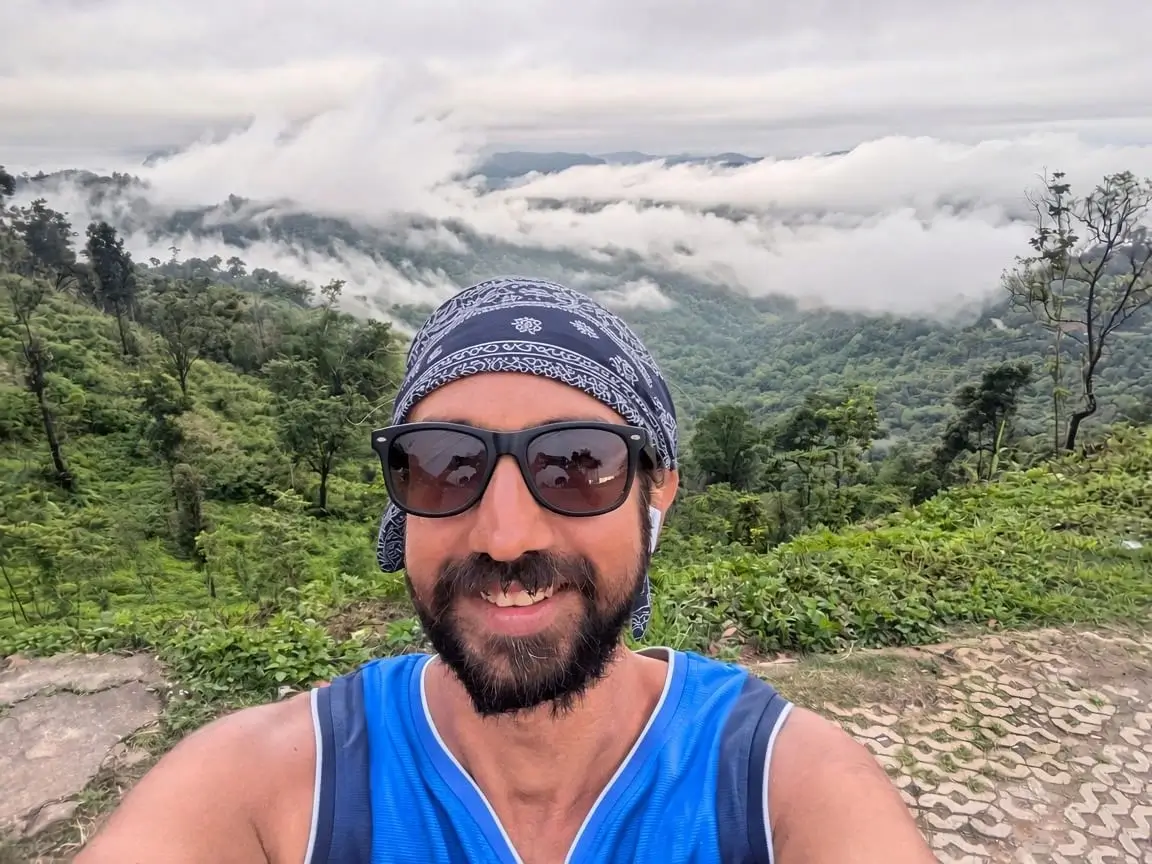
About the author
Written by Dee, Thai-born founder of Off Path Thailand. A scooter ride through Chiang Mai’s mountains nearly a decade ago got me hooked, and I’ve been exploring Thailand’s quiet, hidden places ever since. About the founder
Tell us your dates and vibe. Our team replies within 24 hours to begin crafting your itinerary.
Custom Itinerary Planning: Experience Chiang Mai the Off Path Way
Every journey leaves a footprint. The difference is in how we choose to travel. At Off Path Thailand, we focus on keeping those footprints light. Learn more about sustainable tourism in Thailand and why Off Path travel supports local communities.