
Chiang Mai vs Chiang Rai:
Which Should You Visit?
Two very different northern Thailand cities — same region, completely different character. This guide helps you choose between Chiang Mai vs Chiang Rai based on your travel style, time, and what you actually want from the north.
The honest answer to Chiang Mai vs Chiang Rai
The Chiang Mai vs Chiang Rai question comes up on almost every northern Thailand itinerary. The honest answer is that they are not really competing with each other — they are two very different cities that serve different purposes on a northern Thailand trip. Choosing between them without understanding what each does well leads to the wrong decision almost every time.
Chiang Mai is the cultural and logistical heart of the north — a city with depth, history, food, and enough variety to fill a week without running out of things that feel genuinely worthwhile. Chiang Rai is quieter, less developed, more border-town in character, and home to a handful of experiences — particularly its extraordinary temples — that you cannot get anywhere else in Thailand. The best northern Thailand itineraries include both. But if you only have time for one, the choice depends on what kind of traveller you are.
I’ve spent years exploring both cities — living in Chiang Mai, making regular trips north to Chiang Rai and the surrounding highlands. This Chiang Mai vs Chiang Rai guide is built from that experience, not from a list of things to do scraped from a travel aggregator. See the northern Thailand destinations guide for the broader picture of what the region contains beyond both cities.
Chiang Mai vs Chiang Rai — at a glance
A quick comparison of both cities across the factors that matter most when planning a northern Thailand trip.
| Factor | Chiang Mai | Chiang Rai |
|---|---|---|
| Best for | Cultural immersion, food, longer stays Wins | Temples, border region, quieter pace |
| Temples | 300+ temples, Old City moat, Doi Suthep | White Temple, Blue Temple — both extraordinary Wins |
| Food scene | Khao soi, Nimman cafés, night markets Wins | Smaller, more local, less variety |
| Nature / day trips | Doi Inthanon, Chiang Dao, Mae Hong Son Wins | Golden Triangle, highland villages, Doi Tung |
| Atmosphere | Lively, layered, international | Quieter, more local, border-town feel Wins |
| Accommodation | Wide range — budget to boutique Wins | Fewer options, smaller scale |
| Transport links | International airport, trains, buses Wins | Domestic airport, minivans, buses |
| Ideal stay length | 4–7 days minimum Wins | 1–2 days is often enough |
| Distance from Bangkok | ~1 hr flight / 10 hrs train Tie | ~1.5 hrs flight / via Chiang Mai |
| Off-path potential | Chiang Dao, Nan, Mae Hong Son nearby Wins | Golden Triangle, highland routes |
Chiang Mai vs Chiang Rai temples — two completely different experiences
When it comes to temples, the Chiang Mai vs Chiang Rai comparison is genuinely difficult because both cities win for different reasons.
Chiang Mai has over 300 temples, and the Tourism Authority of Thailand Chiang Mai page lists the most significant — though the ones worth seeking out are rarely the most famous ones. The most significant — Doi Suthep, Wat Phra Singh, Wat Chedi Luang, Wat Suan Dok, Wat Umong — are spread across the Old City and surrounding hills. Walking the Old City moat district at dusk, with temple bells in the distance and orange-robed monks passing on foot, gives you a feeling of being inside living history rather than visiting a monument. The Chiang Mai hidden gems guide covers the temples most visitors never reach.
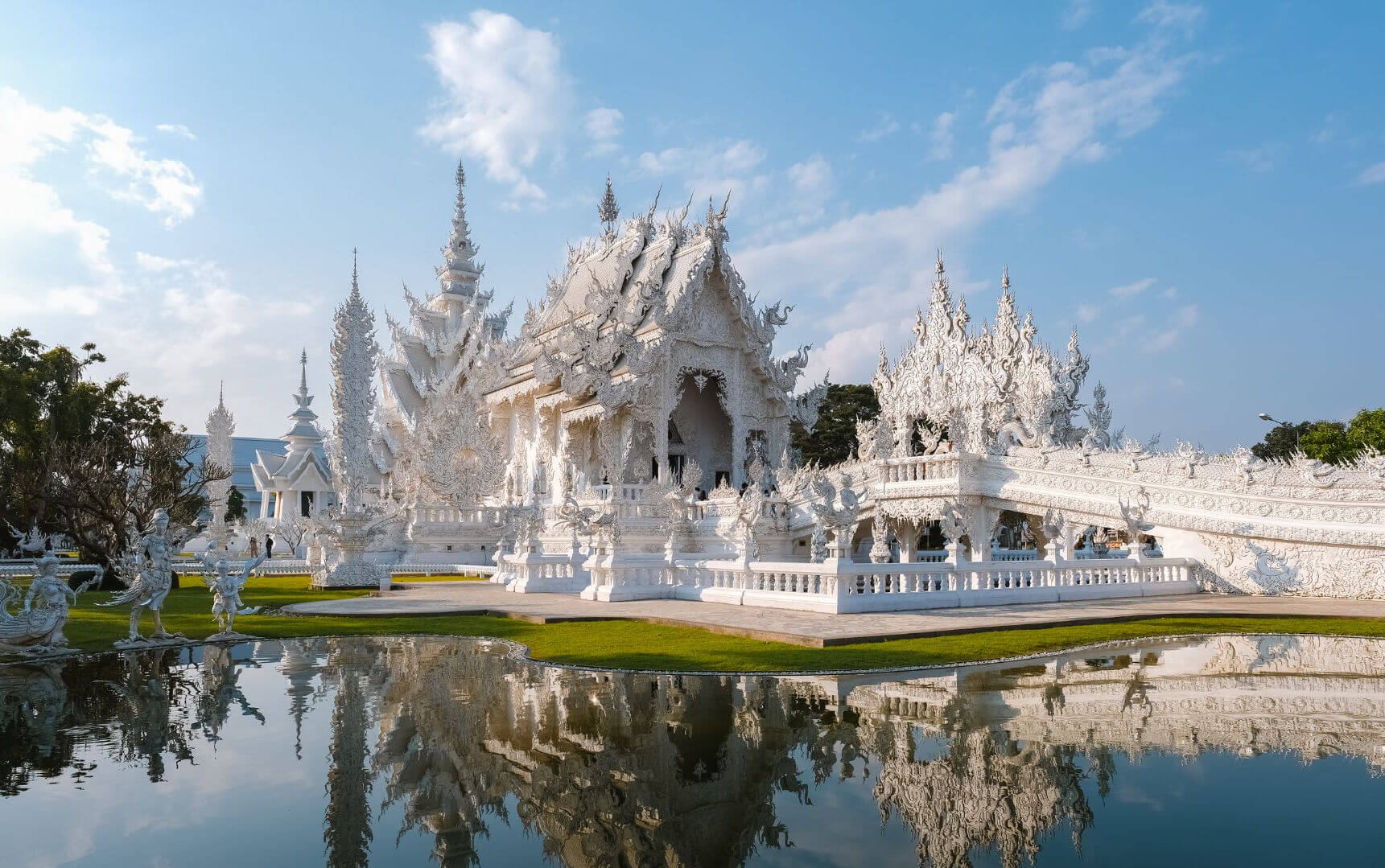
Chiang Rai’s temples are fewer but more visually dramatic. The White Temple — Wat Rong Khun — is unlike anything else in Thailand: a contemporary Buddhist artwork built entirely in white mirror mosaic by artist Chalermchai Kositpipat, still unfinished and still breathtaking. The Blue Temple nearby is equally striking in a completely different way. Neither belongs to the traditional temple category. They are art installations on a sacred scale, and no photograph quite prepares you for either one in person. For temple architecture alone, Chiang Rai wins on spectacle.
Chiang Mai vs Chiang Rai food — depth vs simplicity
On food, Chiang Mai vs Chiang Rai is not a close contest — Chiang Mai wins clearly. The city has one of the best food scenes in Southeast Asia, anchored by northern Thai cuisine that is genuinely distinct from the dishes most visitors know from Bangkok or beach resort menus.
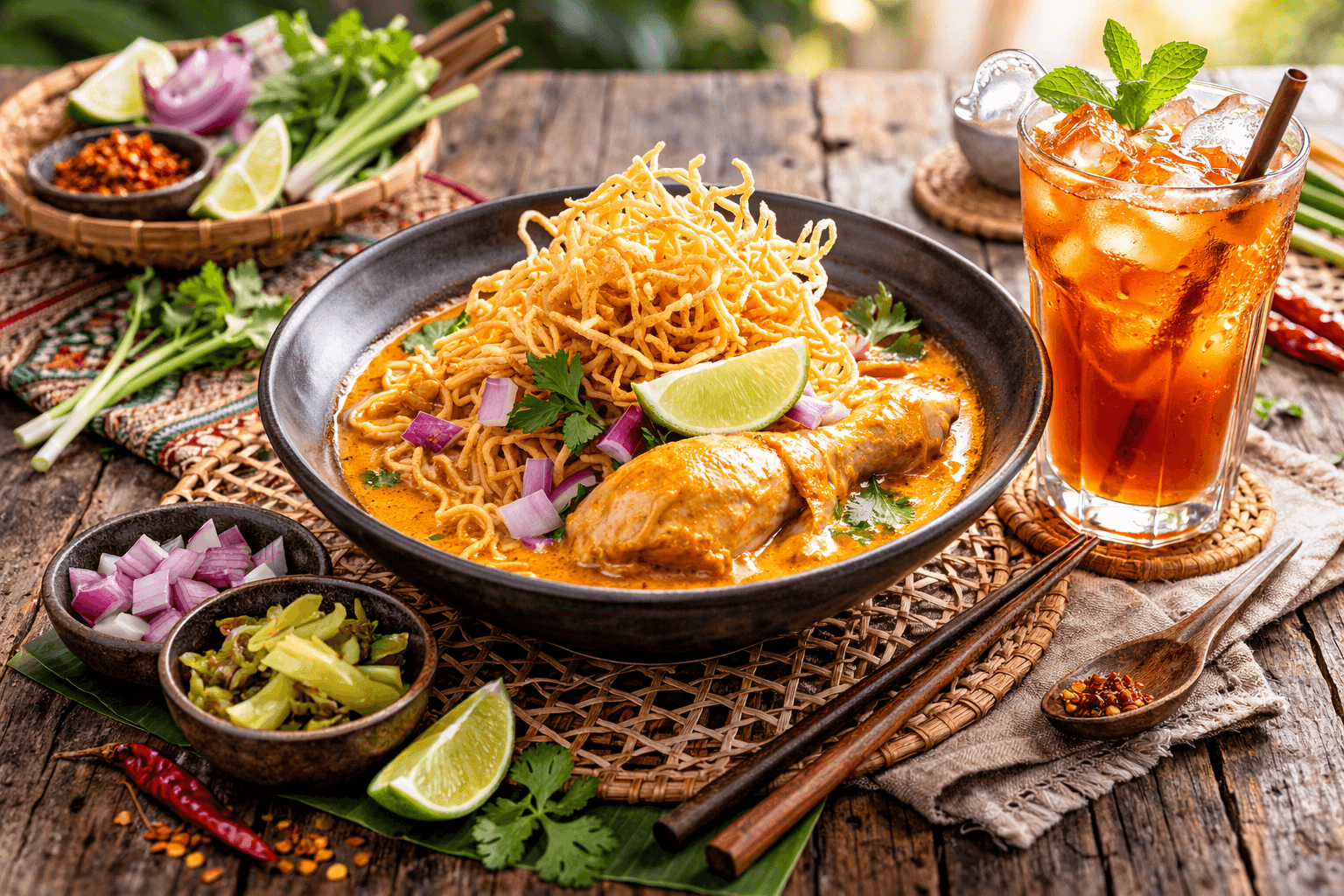
Khao soi — the curry noodle soup that defines northern Thai cooking — is worth the trip to Chiang Mai on its own. But there is also sai oua (northern Thai sausage), nam prik noom (roasted green chilli dip), gaeng hang lay (Burmese-influenced pork curry), and a cafe scene in Nimman that rivals anything in Bangkok. The street food pricing guide gives a sense of what to budget across northern Thailand.
Chiang Rai’s food scene is smaller and more local in character — fewer tourist-facing restaurants, more neighbourhood canteens and market stalls. That is not necessarily a disadvantage if you know where to look, but the range and depth of Chiang Mai’s food culture simply cannot be matched in a city of Chiang Rai’s size. For food-focused travel, Chiang Mai is the clear choice in any Chiang Mai vs Chiang Rai decision.
Chiang Mai vs Chiang Rai for nature and mountain experiences
Both cities offer access to northern Thailand’s mountain landscape, but the range of day trips from Chiang Mai is significantly wider. Doi Inthanon — Thailand’s highest peak — is under two hours away. Chiang Dao, with its dramatic limestone massif and cave system, is 70 km north. The mountain loop to Pai and Mae Hong Son takes you through some of the most extraordinary highland scenery in Southeast Asia. Nan Province, one of the most intact cultural destinations in Thailand, is accessible from Chiang Mai as a multi-day extension.
Chiang Rai’s nature draw is the Golden Triangle — the historic opium trade junction where Thailand, Laos, and Myanmar meet. The atmosphere is genuinely different from anywhere else in the country: a wide river, three countries visible from one riverbank, and a border-town energy that feels nothing like the resort areas further south. Doi Tung Royal Villa and its gardens are worth a half day, and the highland tea and coffee villages north of the city offer some of the most authentic community experiences in northern Thailand.
For sheer range of nature and mountain experiences, Chiang Mai wins the Chiang Mai vs Chiang Rai comparison. But the Golden Triangle alone is worth the journey north — it is the kind of place that stays in your memory long after more polished destinations have faded.

Chiang Mai vs Chiang Rai atmosphere — lively city vs quiet border town
Atmosphere is where the Chiang Mai vs Chiang Rai gap is most felt in person. Chiang Mai has the energy of a real city — university students, expats, digital nomads, local families, and international visitors all moving through the same streets. The Old City has a pulse to it. The Nimman district feels creative and contemporary. The night markets are varied and genuinely local rather than purely tourist-facing. You can spend a week in Chiang Mai and still feel like you have only scratched the surface.
Chiang Rai is quieter by design. It is a provincial capital, not a traveller hub, and it has not been shaped by tourism the same way Chiang Mai has. The night bazaar is smaller, the streets are calmer after dark, and the pace is slower across the board. For travellers who find Chiang Mai’s energy too busy — or who simply want to experience a Thai northern city that has not been smoothed into something optimised for visitors — Chiang Rai offers exactly that. The Tourism Authority of Thailand describes Chiang Rai as one of the country’s most culturally distinctive provinces — a description that holds up in person.
Neither atmosphere is better — they are different. The Chiang Mai vs Chiang Rai choice on atmosphere depends entirely on what you want the energy of your trip to feel like. One practical note: both cities are affected by the northern Thailand burning season (March to May), when air quality drops significantly. Check IQAir Chiang Rai before travelling during those months.
Chiang Mai vs Chiang Rai — who should go where
The right answer to Chiang Mai vs Chiang Rai depends on your travel style, time, and what you want from northern Thailand. Here is how to think about it.
You want cultural depth
Temples, markets, food, mountain day trips, and the best base for exploring northern Thailand. Chiang Mai is the right choice for most travellers on a first or second northern Thailand visit.
You want spectacle and quiet
The White Temple and Blue Temple are genuinely unmissable. If you want quieter streets, a border-town atmosphere, and experiences away from the main northern Thailand tourist circuit, Chiang Rai delivers.
Visit both
Chiang Rai is 3 hours from Chiang Mai by private vehicle. Most northern Thailand itineraries include both — 4 to 5 days in Chiang Mai as a base, 1 to 2 days in Chiang Rai. The northern Thailand itinerary shows how this works in practice.
Beyond Chiang Mai vs Chiang Rai — the northern Thailand destinations most visitors miss
The Chiang Mai vs Chiang Rai decision matters — but it covers only a fraction of what northern Thailand actually contains. Both cities are well-established on the tourist circuit. The destinations that reveal the region’s real depth are the ones further from that circuit.
Chiang Dao — 70 km north of Chiang Mai — has a limestone massif that rises dramatically from the valley floor, a cave system accessible by longboat, and highland villages where you are more likely to be the only international visitor than one of many. It is one of the most atmospheric destinations in northern Thailand and barely known outside the traveller community that specifically seeks out off-path experiences.
Nan Province is further east — a full day’s drive from Chiang Mai — and home to one of the most culturally preserved communities in the country. UNESCO-recognised for its craft heritage, virtually unvisited by international tourists, and home to landscapes that are genuinely unlike anywhere else in Thailand. The Nan private tour page covers how we build itineraries there.
The northern Thailand private tour page explains how we combine Chiang Mai, Chiang Rai, and the off-path destinations beyond into a single seamless itinerary.


A Chiang Mai vs Chiang Rai guide written by someone who lives in the north

I’ve spent years on both sides of this comparison
I moved to Chiang Mai in my early thirties after renting a motorbike and discovering a version of northern Thailand I’d never seen despite growing up in the country. Since then I’ve made dozens of trips to Chiang Rai, driven the mountain roads between both cities more times than I can count, and built itineraries for guests across the full spectrum of the Chiang Mai vs Chiang Rai question.
My honest view: most people who ask “Chiang Mai or Chiang Rai” should visit both, and then spend their remaining time in a destination that neither city can compete with — Chiang Dao, Nan, or the highland routes north of Mae Hong Son. That is where northern Thailand reveals something genuinely hard to find. Every private tour we build from Chiang Mai is designed around that principle.
Thaewan Founder, Off Path Thailand · Read the full story →FAQ: Chiang Mai vs Chiang Rai
Ready to plan your northern Thailand trip?
Whether you want Chiang Mai, Chiang Rai, or the destinations beyond both — we’ll build your itinerary from scratch. Private vehicle, local knowledge, no group buses.